Why Your Bedroom Feels Too Hot at Night — And What You Can Change
You go to bed feeling tired.
The room seems fine when you first enter it.
Then you get under the covers.
A few minutes later, you throw the blanket off.
You turn the pillow over to find a cooler side.
You move your legs out from under the covers.
Maybe you turn the fan toward the bed.
Then, sometime during the night, you wake up feeling hot again.
If this sounds familiar, the problem may not be as simple as “the weather is hot.”
Your bedroom can feel uncomfortable because of a combination of room temperature, humidity, air movement, sunlight, bedding, mattress materials, and the way the room holds heat.
Research on sleep environments consistently shows that thermal conditions matter. Higher bedroom temperatures have been associated with greater thermal discomfort and poorer self-reported sleep, while heat exposure can increase wakefulness.
The good news is that you do not necessarily need an expensive bedroom makeover.
Sometimes the problem is one small thing that you have never considered.
This guide looks at the most common reasons a bedroom feels too hot at night and what you can change first.

First, Find Out Where the Heat Is Coming From
Before buying cooling sheets, a new mattress, or another fan, take a few minutes to figure out what is actually making the bedroom uncomfortable.
There are two different situations.
The whole room is hot
If you walk into the bedroom and immediately feel that the air is warm, your problem is probably the room environment.
The temperature may be too high.
The room may have poor airflow.
Sunlight may have heated the walls and furniture during the day.
Humidity may also be making the room feel more uncomfortable.
The room feels comfortable, but the bed feels hot
This is different.
You may feel comfortable while standing in the room, but become hot after getting under the covers.
In that case, your bedding, sleepwear, mattress, or the small layer of air around your body may be contributing to the problem.
Research on bedding shows that the thermal resistance of the bedding system affects the temperature conditions around the sleeper.
This distinction matters because changing the thermostat will not necessarily solve a problem that is happening mainly inside the bed.
So before changing anything, ask yourself:
Does the whole bedroom feel hot, or does the bed become hot after I get into it?
That one question can save you from buying the wrong solution.
1. Your Bedroom Is Holding Heat During the Day
One of the easiest things to overlook happens long before bedtime.
The bedroom may be collecting heat throughout the afternoon.
Sunlight entering through the windows can heat the room’s surfaces, and that heat can remain in the room after the sun has moved away.
This is especially noticeable in bedrooms with strong afternoon sunlight.
A room can therefore feel much warmer at night than it did in the morning.
The U.S. Department of Energy notes that windows can contribute to solar heat gain and recommends shading strategies to reduce unwanted heat entering the home.
What to do instead
Pay attention to when your bedroom becomes hottest.
If the room starts getting uncomfortable after direct afternoon sunlight reaches the window, deal with the sunlight before it heats the room.
Close suitable blinds, shades, or curtains during the hottest part of the day.
You do not have to keep the room dark all day.
The important part is preventing strong sunlight from continuously heating the room when you do not need that heat.
Then, when outdoor conditions become cooler, you can use your windows and ventilation strategy appropriately for your climate and home.
The simple idea is:
Do not wait until bedtime to start cooling a room that has been collecting heat for hours.
2. Your Bedding Is Simply Too Warm for the Room
Sometimes the bedroom temperature is reasonable.
The problem starts when you get under the covers.
That can happen when your bedding provides more insulation than you currently need.
A thick comforter, heavy quilt, blanket, and multiple layers may feel comfortable during cooler months.
But using the same combination during a hot season can leave you feeling trapped under your own bedding.
This is not necessarily because one material is “bad.”
The amount and type of insulation matter.
Research on bedding thermal resistance shows that different bedding systems change the range of temperatures in which sleepers feel comfortable.
What to do instead
Look at your entire bed rather than focusing on one product.
Ask yourself:
- Do I really need every blanket on the bed tonight?
- Is the comforter heavier than necessary?
- Am I using a thick blanket underneath another thick layer?
- Would a lighter combination be enough?
Try removing one layer first.
You may discover that the simplest change is also the cheapest.
And if you live somewhere with large seasonal temperature changes, you do not need one bedding setup for the entire year.
A lighter setup for warm months and a warmer setup for cool months is often more practical.

3. Your Bed Has Poor Air Movement Around It
A fan can be running.
The room can still feel uncomfortable.
That may sound strange, but air movement and room temperature are not exactly the same thing.
Moving air across your skin can make you feel cooler even when the room itself has not dramatically changed temperature.
Research on low-energy cooling strategies has found that increasing air movement with fans can enhance thermal comfort, especially when combined with other passive strategies.
But simply putting a fan somewhere in the bedroom does not guarantee good airflow.
Its position matters.
What to do instead
Look at how air moves through your bedroom.
Is the fan blocked by furniture?
Is it pointed toward a wall where it does little to improve air movement around the bed?
Is the room arranged so that air cannot move easily?
Try changing the fan’s position and direction.
You may also need to consider where fresh outdoor air can enter and where warmer air can leave, depending on your home’s layout, outdoor temperature, security, and ventilation conditions.
The goal is not necessarily to make the fan stronger.
The goal is to make the air movement more useful.
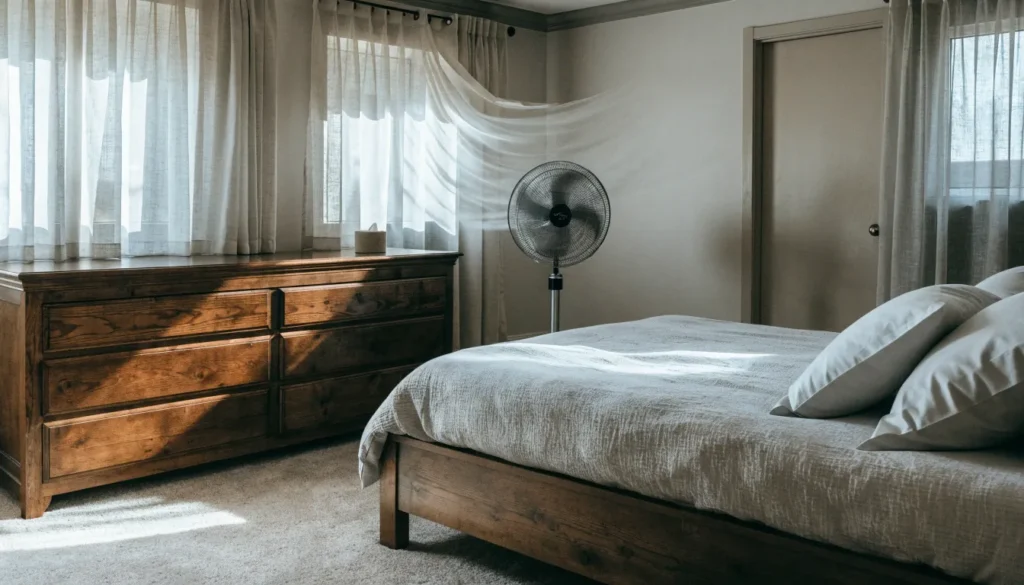
4. The Room Is Humid, Not Just Hot
Temperature is not the only part of thermal comfort.
Humidity matters too.
A warm room with high humidity can feel much more uncomfortable than a room at the same temperature with lower humidity.
Research on humid heat exposure during sleep has found increased wakefulness and changes in body temperature regulation under hot, humid conditions.
This is particularly relevant in climates where summer nights remain warm and humid.
You may therefore keep lowering the temperature and still wonder why the bedroom does not feel comfortable.
What to do instead
If your bedroom regularly feels hot and sticky, humidity may be part of the problem.
If you have an indoor humidity meter, check what is actually happening rather than guessing.
Then consider whether your home needs better ventilation or dehumidification, depending on your climate and the equipment available to you.
Do not assume that turning the temperature down is always the only answer.
Sometimes the air feels uncomfortable because it is both warm and humid.

5. Your Mattress May Be Part of the Problem
Sometimes you change the sheets, remove the blanket, and turn on the fan, but you still feel hot where your body is touching the bed.
That is worth paying attention to.
Your mattress is underneath you for most of the night, so its construction can affect how heat and moisture behave around your body.
Some mattresses can feel warmer than others depending on their materials, construction, cover, and how much air can move through them. Sleep Foundation also notes that mattress choice is part of creating a comfortable sleep environment and that some people may find certain mattress materials warmer or cooler than others.
This does not mean one mattress material is automatically better for everyone.
Your sleeping position, body, room temperature, and personal preference all matter.
What to do instead
Before replacing a mattress, test the simpler changes first.
Use lighter bedding.
Remove unnecessary layers.
Check whether the room itself is too warm.
Improve air movement.
If the mattress is older and you consistently feel trapped by heat around your body even after making those changes, then mattress construction becomes worth considering.
The important thing is not to buy a new mattress simply because an advertisement calls it “cooling.”
Look at the actual construction and whether it suits your sleeping conditions.

6. Your Pillow Is Making You Feel Hot Around Your Head
Most people think about cooling the room and the bed.
They forget about the pillow.
But your head and neck are in contact with the pillow for hours.
If your pillow feels warm, holds heat, or does not allow much air movement around your head, it can become one of the first things you notice when trying to sleep.
This can be particularly frustrating because the rest of the bedroom may feel reasonably comfortable.
You keep turning the pillow over looking for the cool side.
Then a few minutes later, that side feels warm too.
What to do instead
First, check the pillow itself.
Is it very thick?
Does it feel dense?
Is it covered by several layers of fabric?
Does it stay warm after only a short time?
You may not need a completely different pillow.
Sometimes a lighter pillowcase or removing an unnecessary protective layer is enough to change how the pillow feels.
If you are already planning to replace the pillow, pay attention to how the manufacturer describes its construction and airflow rather than choosing a product simply because it uses the word cooling.
Remember that comfort is personal.
A pillow that feels cool to one person may feel perfectly ordinary to another.

7. Your Curtains May Be Solving the Wrong Problem
Curtains can help keep a bedroom cooler.
But they can also create a problem if you use them without thinking about when the outdoor air is actually cooler than the room.
During a hot sunny afternoon, keeping the curtains or blinds closed can reduce unwanted solar heat entering through the window. The U.S. Department of Energy recommends shading strategies to reduce solar heat gain through windows.
But later in the evening, the situation may change.
If the outdoor air becomes cooler than the bedroom and your windows are suitable for ventilation, keeping everything tightly closed may prevent you from taking advantage of that cooler air.
What to do instead
Pay attention to the temperature outside, not just the clock.
During the hottest sunny part of the day, use your window coverings to reduce direct heat entering the room.
Later, when outdoor conditions are cooler, consider whether opening windows can help release accumulated heat and improve ventilation.
Of course, this depends on your climate, outdoor air quality, security, insects, and the design of your home.
The useful lesson is simple:
Window coverings and ventilation have different jobs.
Use each one when it actually helps.

8. Your Bedroom Is Not Getting Enough Air Movement
There is a difference between having a fan in the room and having useful air movement around your body.
A fan sitting in the corner may technically be running, but if its airflow is blocked or poorly directed, you may not feel much benefit.
Air movement can improve thermal comfort by helping heat leave the skin. Research on personal and environmental air movement has found that increased air speed can improve thermal comfort under warm conditions.
This is why a gentle breeze can sometimes make a room feel much more comfortable even when the thermometer has barely changed.
What to do instead
Look at the path between the fan and your sleeping position.
Is a large dresser blocking the airflow?
Is the fan pointed directly into a wall?
Is it positioned where the air barely reaches the bed?
Try a different position.
You can also experiment with the direction and speed rather than automatically choosing the highest setting.
And if your bedroom has an appropriate window or ventilation route, consider whether air can actually move through the room rather than simply circulate around one corner.
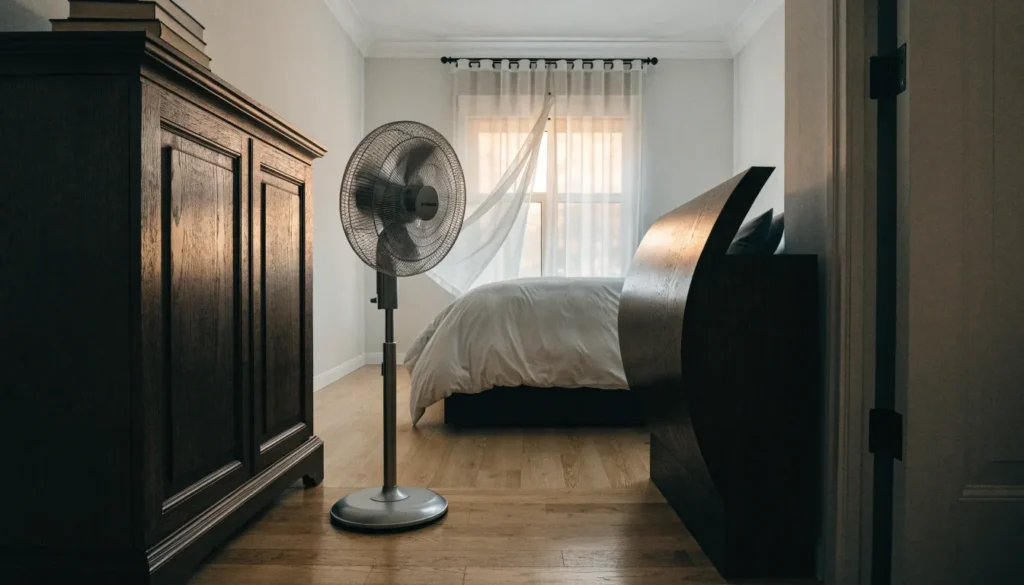
9. Your Bed Is Too Far From the Coolest Part of the Room
This is a surprisingly practical problem.
Not every part of a bedroom has the same conditions.
One side may receive direct afternoon sun.
Another side may be closer to a window.
One corner may sit directly beneath a ceiling fan.
Another may be surrounded by large pieces of furniture.
So if you always put your bed in the same place because that is where it has always been, you may never notice that another position would feel different.
This does not mean you should randomly move your bed every night.
It means you should look at your room as a thermal space, not just a furniture layout.
What to do instead
Think about where heat enters and where air moves.
Ask:
- Which wall gets the most afternoon sunlight?
- Where is the main source of airflow?
- Is the bed blocking a useful ventilation path?
- Is one side of the room noticeably warmer?
- Is the head of the bed pushed against a wall that becomes warm during the day?
You may discover that a small furniture adjustment makes the room more comfortable without buying anything.
This is also where bedroom layout becomes practical.
A good arrangement is not only about making the room look balanced.
It should also work with the conditions of the room.

10. You and Your Partner May Simply Sleep at Different Temperatures
This is one of the most frustrating bedroom problems.
You are too hot.
Your partner is cold.
You remove the blanket.
They pull it back up.
You turn the fan toward the bed.
They complain that it is too cold.
Neither person is necessarily doing anything wrong.
People can have different thermal preferences.
Recent sleep-environment research also found differences in preferred thermal sensation among sleepers, while Sleep Foundation notes that some people naturally sleep hotter or cooler than others.
What to do instead
Instead of trying to make the entire bed feel exactly the same, create some flexibility.
For example, you can use separate lighter blankets or duvets so each person can adjust their own layer.
One person can use a thinner cover while the other keeps an additional layer.
This can be much easier than repeatedly changing the entire bedroom temperature.
The same idea works if one person prefers more airflow.
You can sometimes position the fan so that it improves air movement without blowing directly onto the other person.
The goal is not to find one perfect temperature that both people magically prefer.
It is to make the sleeping setup adjustable.

11. Your Electronics and Lighting Are Adding Heat
This is usually not the biggest source of bedroom heat.
But in a small room, several heat-producing devices can contribute to the overall environment.
Think about what is running near the bed:
A television.
A desktop computer.
A gaming system.
Multiple chargers.
A bright lamp.
Other electronics that remain powered for hours.
You should not expect switching off one phone charger to transform a hot bedroom.
That would be an exaggeration.
But if the room is already warm, reducing unnecessary heat sources is a sensible part of managing the overall environment.
What to do instead
Turn off devices you do not need running overnight.
Avoid leaving a computer or gaming system operating unnecessarily in a closed bedroom.
Switch off unnecessary lighting.
And pay attention to equipment that generates noticeable heat.
This is a small change, but several small sources can matter when combined with poor ventilation and a warm outdoor climate.

12. You Are Trying to Cool the Bed When the Whole Room Needs Attention
This is the mistake that ties everything together.
You buy new sheets.
Then a new pillow.
Then another blanket.
Then a fan.
But the bedroom still feels hot.
At that point, stop buying things for a moment.
Look at the room.
If the entire bedroom is warm, changing the sheet material cannot solve the main problem.
If the room is comfortable but you become hot only after getting under the covers, then bedding becomes much more relevant.
If your pillow is the only thing that feels hot, focus there.
If the room becomes unbearable after hours of afternoon sunlight, address the window first.
The solution should match the source of the problem.
A simple way to diagnose it
Hot room before bed?
Start with temperature, sunlight, humidity, and ventilation.
Comfortable room but hot under the covers?
Look at bedding layers, sleepwear, and the mattress.
Only your head feels hot?
Look at the pillow and pillowcase.
Hot on one side of the room?
Look at sunlight, airflow, and furniture position.
You are hot but your partner is cold?
Make the bedding more individually adjustable.
This approach can save you money because you are fixing the cause, not simply adding another product.

How to Cool Your Bedroom Without Buying Everything New
Once you know what is making the room feel hot, you can make changes in the right order.
You do not need to replace your mattress, bedding, curtains, fan, and furniture at the same time.
In fact, doing that makes it difficult to know which change actually helped.
Start with the simplest problem you can identify.
If sunlight is heating the room, deal with the window.
If the whole room is warm, look at temperature and airflow.
If only the bed feels hot, look at bedding and the mattress.
If you and your partner have different preferences, make the bedding more flexible.
This approach is cheaper and usually more useful than buying products based only on the word “cooling.”
Try These Changes in This Order
If you are not sure where to start, work through the bedroom in this order.
1. Check the room itself
Is the entire bedroom hot before you get into bed?
If yes, start with the room rather than the sheets.
Look at sunlight, ventilation, air movement, humidity, and your cooling system.
2. Check the bedding
If the room feels comfortable but you become hot after getting under the covers, remove one layer.
Try a lighter blanket or simpler bedding arrangement.
3. Check the pillow
If your head and neck are noticeably warmer than the rest of your body, look at the pillow and pillowcase.
4. Check the mattress
If your body feels hot where it is in contact with the bed even after simplifying the bedding, the mattress may be worth investigating.
5. Check your sleeping arrangement
If another person shares the bed, ask whether both of you actually need the same amount of bedding.
You may find that separate blankets solve a problem that changing the whole room cannot.
What About “Cooling” Sheets?
This is where it is easy to get carried away with product claims.
You will see sheets advertised as cooling, breathable, moisture-wicking, temperature-regulating, and similar terms.
Some bedding materials and constructions can influence thermal comfort.
But that does not mean every product with a “cooling” label will produce the same result for every sleeper.
Research on different bedding and sleepwear fibres shows that textile properties can affect thermal conditions, but results vary by material and temperature.
A 2025 systematic review of bedding-based cooling strategies also found that these interventions could affect body cooling, but the evidence was too uncertain to conclude that they consistently improve objective sleep outcomes.
There is also newer preliminary research specifically on cooling sheets that reported improvements in perceived sleep and heat-related sleep problems, but the study was a non-randomized pilot and the researchers said further controlled research is needed.
So the sensible approach is:
Treat cooling sheets as one possible part of the solution, not the entire solution.
If your bedroom is genuinely hot, changing the sheets while leaving the underlying heat problem untouched may not be enough.
A Simple Nighttime Test
If you are still unsure what is causing the problem, try a simple experiment.
Do not change five things at once.
Instead, change one thing for a night or two and pay attention to what happens.
For example:
Night 1: Remove one heavy bedding layer.
Night 2: Keep the lighter bedding and improve air movement.
Night 3: Try the same setup with better daytime window shading.
You do not need a complicated spreadsheet.
Simply notice:
- Did the room feel hot before bed?
- Did you become hot after getting under the covers?
- Did you wake up feeling warm?
- Did the pillow feel uncomfortable?
- Did the fan actually reach the bed?
- Did the room feel better after reducing bedding?
This can tell you much more than guessing.
And if a change does nothing, that is useful information too.
It means you can stop spending money on that particular solution.
When the Bedroom Is Hot Because of the Building, Not the Decor
Sometimes the bedroom itself is not the main problem.
The building may simply hold heat.
A top-floor room can receive more heat from the roof.
A room with strong afternoon sun can stay warm for hours.
Poor insulation can allow outdoor heat to enter.
A small room with limited ventilation can also struggle to release accumulated heat.
In these situations, changing decorative items will only have a limited effect.
You may need a more fundamental solution such as better shading, ventilation, insulation, air conditioning, or another appropriate cooling method.
This is an important distinction because bedroom decor has limits.
Good design can help the room work better, but it cannot overcome every building-level heat problem.
The Bedroom Should Feel Comfortable Before It Looks Beautiful
It is easy to focus on how a bedroom looks.
The right bedding.
The right rug.
The right curtains.
The right colors.
But a bedroom is not only something you look at.
You spend hours inside it.
That means comfort should be part of the design decision.
A beautifully decorated bedroom that leaves you sweating under the covers is not solving the real problem.
Likewise, you do not need to turn the room into a laboratory.
Start with the basics.
Make the room comfortable.
Then make it beautiful.
That order is often more useful than buying decorative products first.
Frequently Asked Questions
What temperature should a bedroom be at night?
There is no single temperature that works perfectly for every person. A 2026 field study of real bedrooms found the lowest thermal dissatisfaction at approximately 24–24.6°C in its summer study conditions, with slightly cool thermal sensations associated with better self-reported sleep. Individual preferences and bedding insulation still affected comfort.
Use that research as a reference rather than a strict rule for your bedroom.
Why am I hot in bed but the bedroom feels cool?
Your bedding, mattress, pillow, sleepwear, or the amount of insulation around your body may be contributing to the problem. If the room itself feels comfortable but you become hot after getting into bed, start by reducing unnecessary bedding layers.
Do cooling sheets really work?
They may help some people feel cooler, but results are not guaranteed. Research suggests bedding can influence body cooling and thermal comfort, while evidence that cooling bedding consistently improves objective sleep outcomes remains uncertain.
Is it better to sleep with a fan on?
Air movement can improve thermal comfort in warm conditions, but the benefit depends on how the air is moving around you. A fan that is blocked or poorly positioned may not be very useful. Fans can also be used alongside other cooling and ventilation strategies rather than treated as the only solution.
Should I remove my bedroom rug if the room feels hot?
Usually, a bedroom rug is not the first thing to change when dealing with nighttime heat. Look at the room temperature, sunlight, airflow, humidity, and bedding first. A rug may affect how the room feels underfoot, but it is unlikely to be the main source of a significant nighttime heat problem.
Why is my bedroom hotter than the rest of my house?
The bedroom may receive more direct sunlight, have poorer airflow, be on a warmer part of the building, or have different insulation and ventilation conditions. Compare when and where the room becomes warm rather than assuming the problem is caused by the bedding.
What should I change first if my bedroom is too hot?
First determine whether the room is hot or the bed is hot. If the entire room is warm, start with temperature, sunlight, airflow, and humidity. If the room feels comfortable but you become hot in bed, start with bedding layers, sleepwear, the pillow, and eventually the mattress.
Final Thought
A hot bedroom does not always need an expensive solution.
Sometimes the problem is a thick comforter that is no longer appropriate for the season.
Sometimes the afternoon sun has been heating the room for hours.
Sometimes the fan simply is not moving air where you need it.
Sometimes the room is comfortable but the bed is holding too much heat.
And sometimes the real problem is the building itself.
The important thing is to find the source before buying another product.
Start with the room.
Then look at the bed.
Then look at the smaller details.
Fix the source first. Buy the solution second.
That is a much better way to create a bedroom that is not only attractive, but actually comfortable to live and sleep in.