Choosing the Right Pillows for Sleep and Bedroom Decor to Avoid Sleep Ache
Pillows do much more than support our head – they anchor the entire feel of a bedroom. The right pillows can turn a space serene and inviting; the wrong ones can make it feel crowded or “off.” In a calm bedroom, pillows blend into the design, adding softness without stealing focus. Negative space is key: leaving a bit of blank wall or headboard above the pillows is like a visual breath, a pause that balances the room. As one designer notes, pillows should “support rest, not complicate it…add softness without excess and structure without rigidity”. In practice, that means avoiding pillows that are too plump or too flat, and arranging them in a way that feels balanced and intentional, not fussy.
A few well-proportioned pillows on a bed create a calm, balanced look. In this serene arrangement, neutral tones and gentle textures let the bed breathe, inviting rest.
Overstuffed vs. Flat Pillows and Styling
In recent trends, designers are steering away from the ultra-plush, “chopped” pillows of the 80s and 90s. Overstuffed pillows with crisp corners can make a bed look stiff or artificially staged. By contrast, flatter, relaxed pillows look more natural and inviting. As New York designer Jamie Drake says, “A flat pillow style feels less staged, more natural and inviting.”. In other words, when pillows sit slightly “loose” against the headboard instead of perfectly creased, the bed feels more approachable.
In practice, this might mean choosing lightly filled linen or cotton pillows over rigid foam inserts. One interior pro, Bethany Adams, likens a sofa laden with stiff, puffy pillows to a “fussy decorator” style. She prefers fewer pillows in varied shapes: a couple of large square pillows for support, a long lumbar in front, and perhaps one accent pillow. This creates visual interest without overwhelming the eye. Even on a sofa, Leah Alexander observes that when “decorative pillows take up less space, you have more breathing room”. The same holds for a bed: too many big pillows can make it feel top-heavy or cluttered, whereas a few soft, slightly squishy pillows let the bedding and headboard shine through.
Pillow Size and Height: Perceived Calm and Balance

Pillow proportion is crucial to a peaceful vibe. A low-profile bed or headboard generally “calls” for low-profile pillows, so the look isn’t too busy or tall. Conversely, a tall, grand headboard can handle a bigger pillow stack. As Laurel & Blush’s blogger notes, “A bed with a tall headboard can visually support more layers. A lower-profile bed needs restraint to avoid feeling top-heavy”. In a small bedroom, even just two pillows (instead of four) can keep the space feeling open and uncluttered. For example, on a queen bed you might start with two standard sleeping pillows as the base, then add Euro pillows (26×26″ or similar) against the headboard for height and symmetry, and finish with one or two decorative pillows in front for softness. The key is spacing: pillows should touch, but not crowd each other. “Negative space matters,” the blog emphasizes – gaps between pillows let the eye rest and keep the layout “feeling restful rather than staged”. A good rule of thumb is that the top edges of the back pillows sit just below the midpoint of the headboard, leaving some “breathing room” above. This loose arrangement actually feels more intentional and calm than a rigid, identical stack.
Wrong Pillow Height: An Alignment Analogy

 Just as ill-fitting pillows can ruin the look of a bed, they can also subtly affect how your body feels on it. Imagine your spine as a smooth, gentle curve: a very high or very flat pillow introduces an awkward kink in that curve. While we’re not being medical, many sleepers will tell you that a head pitched too far up or down leads to tossing and turning (and that morning neck stiffness we call “sleep ache”). In decor terms, a pillow that’s much taller than your shoulders can stick out visually and physically – it “topples” the bed’s profile and your neck. A pillow that’s too thin, by contrast, lets your head tilt back uncomfortably.
There’s no one-size-fits-all here, but the idea is to keep the neck and shoulders in gentle alignment. One practical trick: after choosing the right fill (feather, foam, etc.), test a few pillow heights. Prop your head on the pillow as if sleeping and see if your neck stays fairly level. If the headboard or wall feels unnaturally close to your head, try a slightly flatter pillow. If it feels like you’re looking at the ceiling too steeply, use a higher-loft pillow behind. The goal is a smooth visual and physical line from mattress to pillow to wall.
Choosing the Right Pillow Height, Size, and Material for Decor Harmony

To create harmony between your pillows and the room, think of pillows like any other decor piece: choose the right scale, color, and texture. Here are some tips to guide your choices:
Height and Size: Match pillows to bed width and height. On a king bed, for example, you can use large (28″–32″) square Euro pillows to echo the bed’s broad scale; on a twin, one large pillow or two small ones suffice. Leave at least a few inches between stacked pillows and the headboard so the wall or headboard color shows through. Avoid tiny throw pillows on large beds – they can look “lost” unless grouped carefully.
Pillow Layers: For a polished look, layer from largest at the back to smallest in front. Sleeping pillows (flat or standard) go nearest the wall, then tall backing pillows (Euro or extra long rectangles), and finally decorative squares or lumbar pillows. For example, a bold lumbar pillow at the center with two matching squares on either side can create a focal point.
Material and Texture: Natural fabrics like linen, cotton, and wool often give a more relaxed, lived-in feel than shiny synthetics. Soft, gentle textures (washed linen, nubby cotton weave, or light knits) add depth without shouting. As one decor expert advises, lean on “warm neutrals, soft whites, muted earth tones… These colors don’t shout. They soothe”. If your bedding is neutral, a pillow with a subtle pattern or stitch can become an accent, but keep the pattern crisp – a wrinkled or “chopped” look can betray how exactly the pillow is filled.
Firmness and Fill: While this borderlines comfort, it’s worth noting that a pillow plump enough to hold its shape will look perkier in photos. Feather-and-down blends or 50/50 goose-down inserts give a naturally rounded look with a bit of sink-in softness. Memory foam or polyester pillows tend to hold a stiff line which can make them look overdressed. Choose the fill that suits your sleeping needs, but keep in mind that an over-packed pillow (even a decorative euro) can look balloon-like and detract from the room’s relaxed vibe.
Color Coordination: Pillows can tie together the palette. For a truly calm space, stick to shades within one tonal family (e.g. creams and warm grays) and use maybe one accent color or pattern for interest. An off-white pillow against a white wall looks airy; a patterned pillow should generally be flat (not puffed) so the design stays visible.Too many floppy or mismatched pillows can make a bed look messy. In this image, the pillows are uneven and the bedding is rumpled. A simpler selection of well-shaped pillows would immediately tidy the look and invite restful sleep.
Quick Refresh: Why a Pillow Fix Feels So Good
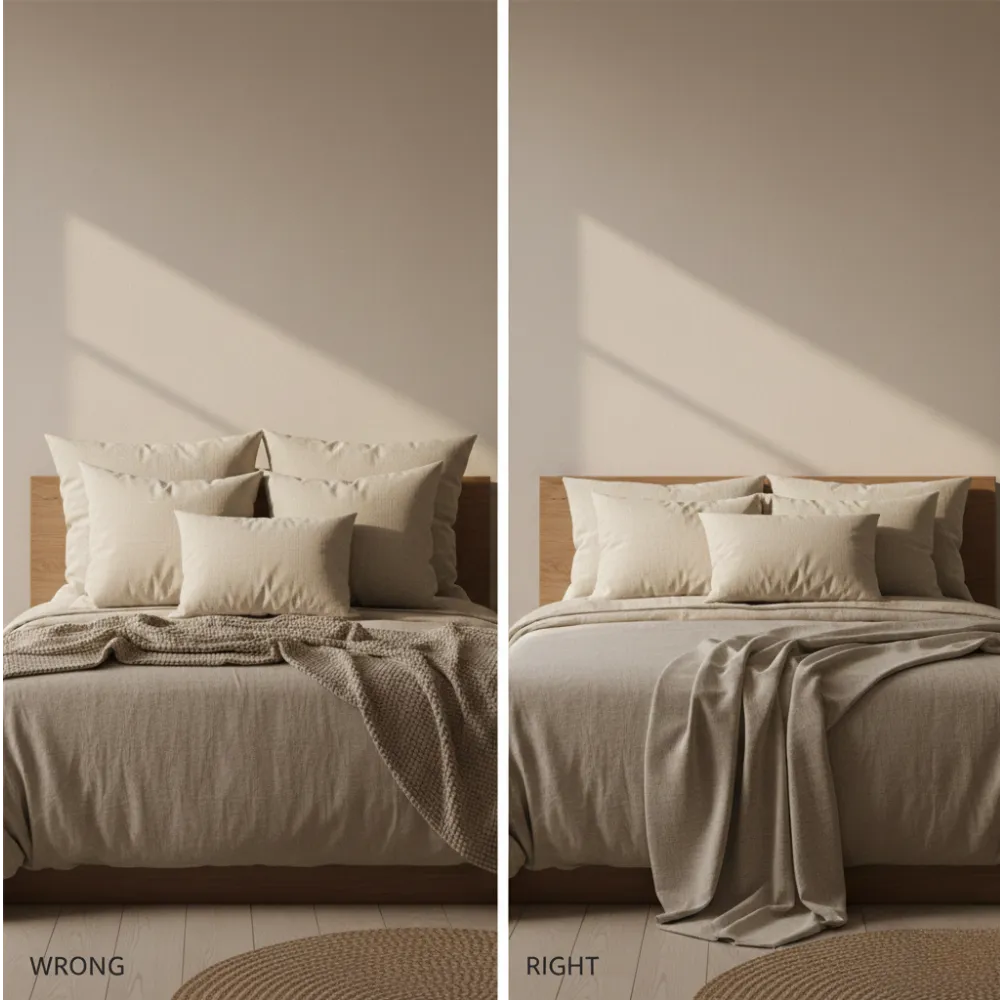 One of the best things about pillows is how fast and easy they are to tweak. Unlike a paint job or new furniture, adjusting pillows is an instant design makeover. Removing one stray bolster, replacing two overstuffed euro shams with slimmer versions, or even plumping the inserts back up can have a startling effect. In decorating, as one designer puts it, the motto is often “do less” – every extra cushion is an extra detail to manage. If your bed feels overly fussy or cramped, start by pulling off the pile of pillows. You’ll likely find the room immediately breathes easier.
Pillow edits also translate to physical comfort. A simpler pillow layout means you’re more likely to find “your spot” easily when you lie down. If picking up all the pillows off the bed feels like a workout, you’ve got too many cushions. In other words, a well-styled bed should move effortlessly between day and night – no tugging pillows around at bedtime. Achieving that ease is part of what makes a bedroom feel truly restorative.
In the end, pillows are a small detail with big impact. By choosing the right height, size, and fill, and giving them room to settle, you’re not just styling a bed – you’re crafting a peaceful backdrop for your rest. When pillows align with the room’s scale and style, the space feels instantly balanced. And when you wake up without the “sleep ache” that comes from a jarring pillow set-up, you’ll know your decor instincts paid off in real comfort.