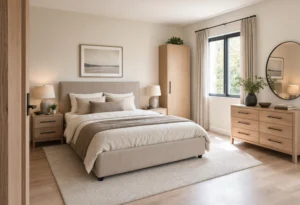
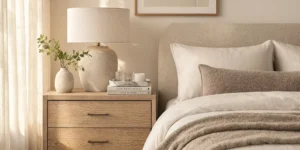
How to Style a Nightstand Without Making It Look Cluttered
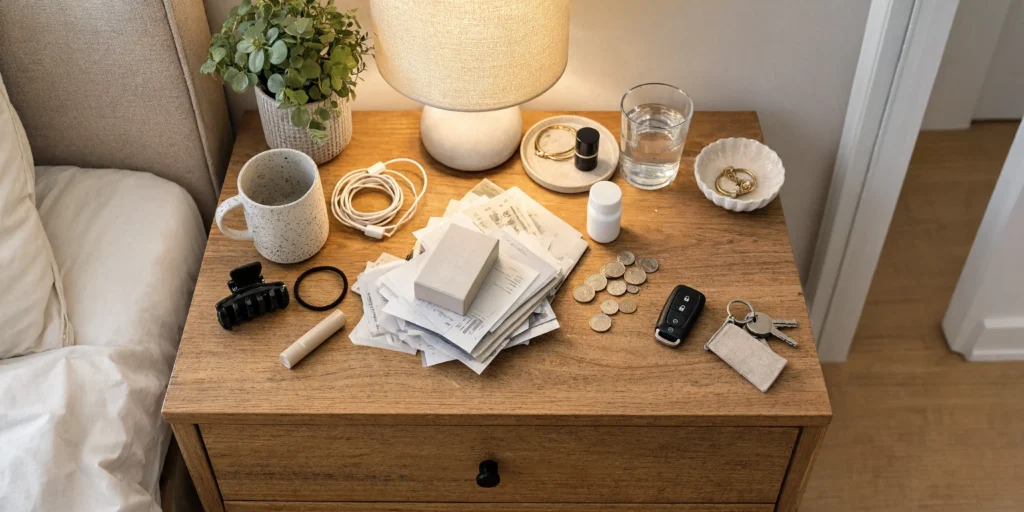
A beautiful bedroom can still feel slightly unfinished when the nightstand is covered with yesterday’s water glass, tangled charging cables, random books, and a collection of small things that never quite found a home.
The problem usually isn’t that the nightstand needs more decoration.
It needs better editing.
A well-styled bedside table has to do two jobs at once. It needs to look intentional enough to belong to the room, while still being useful when you’re reaching for your glasses, turning off the light, or putting your phone down at night.
Interior designers frequently approach nightstands this way: start with the necessities, control clutter, add a small number of decorative elements, and pay attention to scale and placement. Trays can also give small everyday objects a defined home instead of allowing them to spread across the surface.
So instead of giving you another list of random nightstand decor ideas, this guide takes a more useful approach.
We’ll build the nightstand around your actual nighttime routine first—and then make it beautiful.
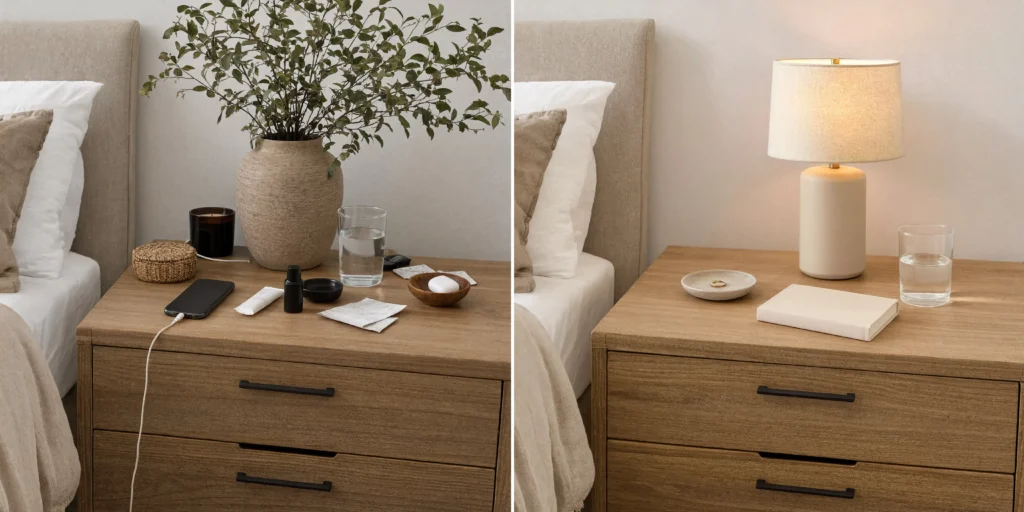
Before You Decorate, Empty the Nightstand
This is the step most decorating guides skip.
Before adding a lamp, vase, books, candle, or anything else, remove everything from the top of your nightstand.
Yes, everything.
Put the items temporarily on the bed or another surface and sort them into three groups:
Keep Here
Things you genuinely use at night or first thing in the morning.
Examples:
- Reading glasses
- A book
- Water
- Phone
- Alarm clock
- Hand cream
- A small dish for jewelry
Move Somewhere Else
Things that belong in the bedroom but don’t need to occupy the nightstand.
Examples:
- Extra skincare
- Hair accessories
- Receipts
- Random papers
- Spare cables
- Products you rarely use
Remove
Anything that has simply become part of the pile.
That old receipt.
The empty bottle.
The charger for a device you no longer own.
The book you finished three months ago.
This matters because decorating a cluttered surface doesn’t solve clutter—it disguises it.
Professional designers quoted by Homes & Gardens similarly recommend starting with necessities and using drawers or shelves to keep useful but visually distracting items out of sight.
The DecorePantry 5-Zone Method
Once the surface is clear, don’t immediately start placing objects.
Instead, think of your nightstand as having five jobs.
This is our DecorePantry framework—not a universal decorating rule, but a simple way to make styling decisions without guessing.
1. Light
You need a practical source of light.
Usually this is:
- A table lamp
- A small reading lamp
- Or a wall-mounted light if the surface is too small
Lighting is often the largest visual element on a nightstand, so it should be decided before the smaller decorative pieces.
2. Essentials
These are the things you actually reach for.
Think:
phone + glasses + book + water
You probably don’t need all four visible at once.
The goal is to keep the things you use accessible without allowing the entire surface to become a storage area.
3. Height
A nightstand can look flat when every object sits at approximately the same level.
A taller element—usually the lamp—creates vertical interest.
If your lamp is already tall, you probably don’t need another large decorative object competing with it.
4. Personality
This is where the bedroom starts feeling like yours.
You might use:
- A small vase
- A framed photograph
- A ceramic object
- A small plant
- A meaningful book
Choose one or two pieces rather than trying to display everything you like.
5. Landing Zone
Small objects need somewhere to land.
A shallow tray or small dish can hold items such as:
- Watch
- Jewelry
- Glasses
- Earbuds
- Keys
Instead of five tiny objects being scattered across the surface, they become one contained visual group.
Trays are frequently recommended by interior designers for exactly this reason: they give loose bedside objects a defined area while keeping the surface visually organized.

Start With the Lamp, Not the Decorations
If your nightstand has enough room for only one substantial object, make the lamp earn its place.
A bedside lamp isn’t simply decoration.
It affects how the nightstand functions, how much free surface remains, and how the entire bedside area feels after dark.
Start by considering:
Where will the light fall?
You should be able to reach the switch comfortably from bed.
Does the lamp overwhelm the nightstand?
A tiny lamp can disappear beside a large bed and substantial furniture, while an oversized lamp can consume most of a narrow bedside surface.
What is already happening around it?
If you have a tall headboard, wall art, or another strong vertical element nearby, you may not need a very tall decorative object on the table as well.
Wayfair’s styling guidance similarly treats the nightstand as both a functional part of the bedtime routine and an opportunity to personalize the bedroom, while Homes & Gardens emphasizes keeping the surface practical and appropriately scaled to the bed and nightstand.
A Simple Test for Lamp Placement
Sit on your bed.
Reach toward the lamp.
If you have to lean forward awkwardly, stretch around another object, or knock something over to reach the switch, the arrangement needs to change.
A beautiful nightstand that is annoying to use isn’t well styled.
Function should win.
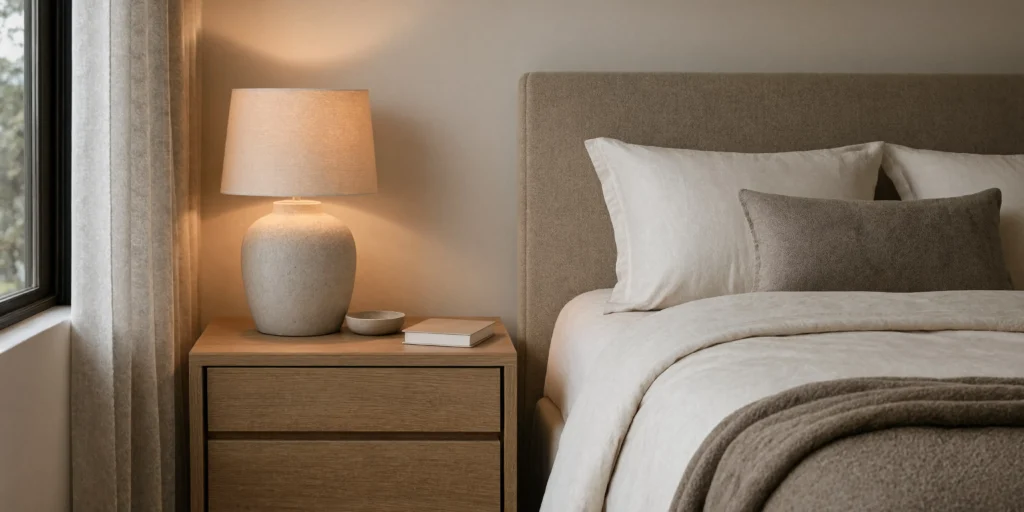
Then Build Around What You Actually Use
Once the lamp is positioned, add your genuine nighttime essentials.
This is where many styled bedrooms go wrong.
A photograph might look beautiful with a vase, decorative box, stack of books, candle, sculpture, flowers, and framed artwork all competing for attention.
But your real nightstand might also need to hold a phone, water, glasses, and a charging cable.
The solution isn’t necessarily a bigger nightstand.
It’s fewer visible objects.
Try this:
If You Read at Night
Keep:
- Lamp
- Current book
- Glasses
- Small tray
Everything else can move elsewhere.
If You Don’t Read
Don’t add books simply because they look good in photographs.
Use the space for something you genuinely enjoy or leave it empty.
If You Need Charging Space
Give the charger a deliberate home rather than allowing the cable to run across the entire surface.
A small cable-management solution can make more difference than another decorative object.
If You Keep Jewelry Beside the Bed
Use a small dish or tray.
The goal is to turn several loose objects into one visual unit.
The Most Important Styling Principle
Here’s the principle I want you to remember throughout this entire guide:
Don’t decorate every available inch of the nightstand.
Negative space is part of the design.
An empty patch of wood, stone, or laminate isn’t wasted space.
It gives the objects around it room to breathe.
This is especially important in bedrooms because the nightstand sits immediately beside the bed. When its surface becomes visually busy, that clutter can become one of the first things you notice when you’re trying to wind down.
Recent bedroom organization guidance likewise emphasizes reducing visible clutter and keeping nighttime spaces intentional rather than filling them with unnecessary objects.

How to Style a Small Nightstand
A small nightstand doesn’t need to look empty.
It just needs to be edited more carefully.
When the surface is narrow, every object has to justify the space it occupies. A large lamp, several books, a vase, a candle, and a tray may look beautiful individually, but together they can leave nowhere for the things you actually need.
The answer is to move some functions away from the surface.
A wall-mounted reading light, for example, can provide the lighting you need without taking up the same surface area as a table lamp. Floating or narrow nightstands can also make better use of limited floor space.
For a small nightstand, try this order:
Lamp → essential item → small decorative element
That’s enough.
If the lamp already provides height and visual interest, you may not need another tall object.
The Small-Nightstand Formula
For a compact bedside table, start with:
- One appropriately sized lamp or wall light
- One practical item
- One small personal or decorative object
For example:
Lamp + current book + small ceramic dish
Or:
Wall sconce + water glass + small vase
Or:
Small lamp + glasses + framed photograph
The important part isn’t the exact combination.
It’s the amount of visual competition.
A small surface usually looks better when the objects form one deliberate group rather than several unrelated clusters.
What If Your Nightstand Is Wide?
A larger nightstand gives you more room, but that doesn’t mean you should fill all of it.
This is where styling can become surprisingly difficult.
A wide surface with only a lamp pushed into one corner can look unfinished.
But covering the entire surface with accessories can make it feel like a display shelf.
Instead, create two visual areas.
Area One: The Functional Zone
Keep the things you reach for here.
This might include:
- Phone
- Glasses
- Book
- Water
- Small tray
Area Two: The Decorative Zone
This is where you can introduce personality.
Try:
- A small vase
- A framed photograph
- A plant
- A decorative object
- A small stack of books
Leave a visible gap between the two areas.
That empty space is what prevents a large nightstand from looking like one continuous pile.

The Rule of Scale: Your Nightstand Shouldn’t Fight Your Bed
One of the easiest mistakes to make is choosing objects that are too large—or too small—for the furniture around them.
Imagine a substantial upholstered bed with a tiny lamp sitting on a narrow little table.
Nothing is technically wrong.
But the proportions feel disconnected.
Now imagine the opposite: a delicate bedside table carrying an oversized lamp with a large shade.
The lamp dominates everything.
Good styling sits somewhere between those extremes.
Look at the whole bedside area.
Don’t ask:
“Is this lamp beautiful?”
Ask:
“Does this lamp belong beside this bed, on this table, in this room?”
That shift in thinking is much more useful.
A designer approach is to consider the nightstand as part of the entire composition, rather than treating it as an isolated decorating surface. Earlier designer guidance similarly recommends beginning with larger elements and then working toward the smaller details.
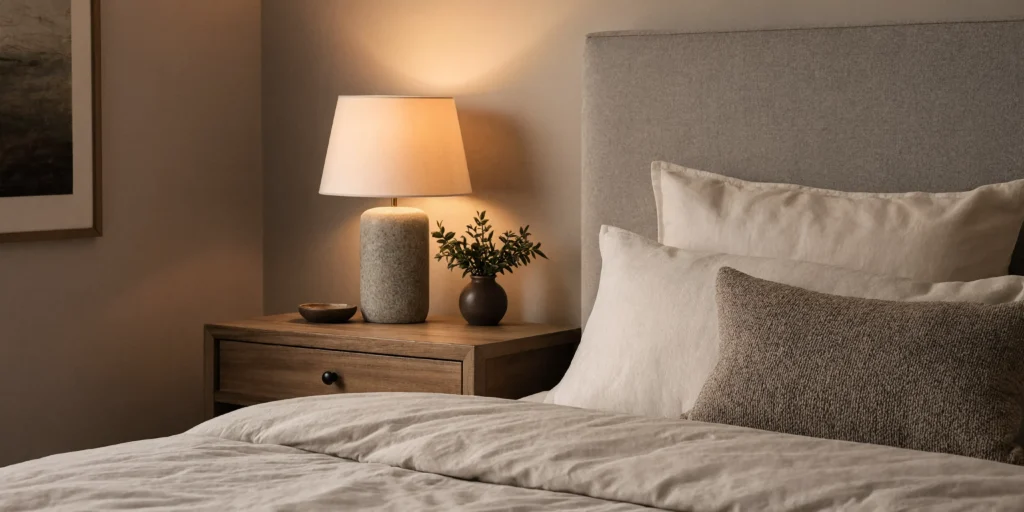
How Tall Should the Lamp Be?
There isn’t one universal lamp height that works for every bedroom.
Your bed height, mattress thickness, headboard, nightstand height, and whether you read in bed all affect the decision.
Instead of memorizing a number, use a practical test.
Sit where you normally sit or lie in bed.
Look toward the lamp.
You want the light source to feel naturally positioned for reading and evening use without forcing you to look directly into an exposed bulb.
Then look at the lamp from across the room.
Does it visually connect with the bed?
Does it feel lost?
Or does it dominate the entire bedside?
Your eyes will often tell you more than a rigid measurement.
Should Both Nightstands Match?
They can.
But they don’t have to.
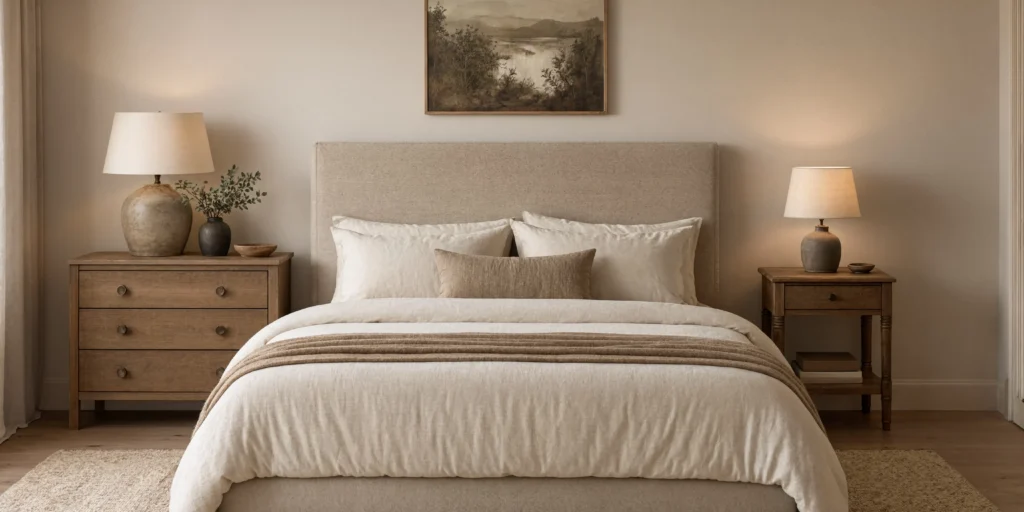
Matching nightstands create symmetry, which can make a bedroom feel orderly and calm.
However, two completely different bedside tables can also work beautifully when they share something visually.
For example:
Same color, different shape
Two wood nightstands with different silhouettes.
Same lamp style, different furniture
Different tables connected by matching lamps.
Same visual weight, different materials
A wood nightstand on one side and a painted table on the other, balanced with similarly scaled lighting.
The goal isn’t necessarily identical.
The goal is related.
When Mismatched Nightstands Work Best
Mismatched tables can be particularly useful when the two sides of the bed have different practical needs.
Perhaps one person needs:
- More drawer storage
- A larger reading lamp
- Space for books
while the other side only needs:
- A small lamp
- Phone space
- A glass of water
Forcing both sides to have identical furniture can sometimes waste valuable space.
A more thoughtful approach is to give each side what it needs while maintaining a visual relationship between them.
Three DecorePantry Styling Levels
Not everyone wants the same bedroom.
So instead of saying there is one “correct” nightstand arrangement, choose the level that matches your lifestyle.
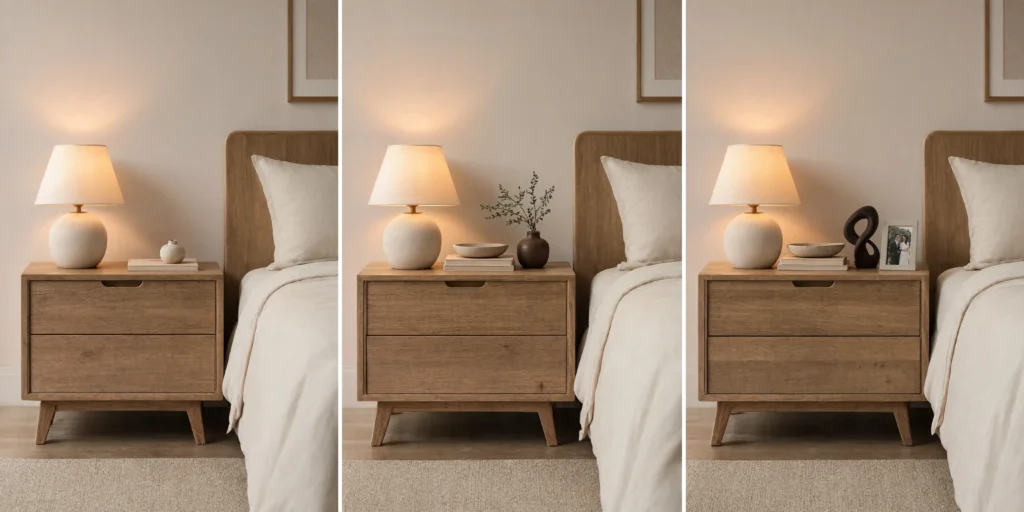
Level 1 — The Quiet Minimalist
This is for someone who wants the bedside area to disappear into the room rather than become a focal point.
Try:
Lamp + book + one small object
Keep the colors restrained.
Use texture instead of lots of accessories to create interest.
A ceramic lamp, linen shade, natural wood, or stone object can make a simple arrangement feel considered without adding visual noise.
Level 2 — The Balanced Bedroom
This is the middle ground.
You want the nightstand to look styled, but you also want it to work every night.
Try:
Lamp + book stack + small tray + one decorative object
The tray controls the small essentials.
The books add a little height.
The decorative object provides personality.
Nothing needs to be oversized.
Level 3 — The Collected Look
This is for someone who enjoys a more layered bedroom.
Try:
Lamp + books + tray + decorative object + personal piece
You can introduce more texture and character here, but keep an eye on the overall silhouette.
The trick is to layer upward rather than outward.
A small stack of books can create height without taking up much additional surface width.
A framed photograph can lean against the wall rather than requiring another large object.
A tray can combine several small objects into one visual group.
Don’t Forget the Wall Above the Nightstand
The surface isn’t the only place you can create visual interest.
If the nightstand feels crowded, look upward.
A piece of artwork, a mirror, a small shelf, or a wall-mounted light can shift some of the visual weight away from the tabletop.
This is especially useful in small bedrooms.
Instead of asking:
“What else can I fit on this table?”
ask:
“What can move onto the wall?”
That simple question can completely change how much space you need on the surface.
Just remember that wall decor should still relate to the scale of the bedside furniture rather than feeling randomly placed.
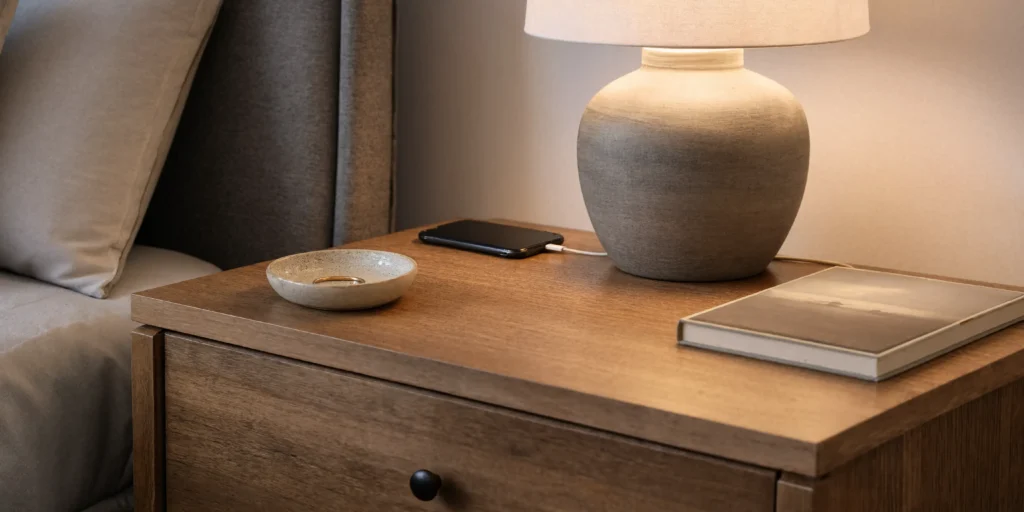
The Charger Problem Nobody Shows in Bedroom Photos
Let’s talk about the thing that ruins more beautiful nightstands than almost anything else:
the charging cable.
You can have the perfect lamp, the perfect vase, and the perfect stack of books.
Then a cable snakes across the surface, hangs over the edge, and suddenly the whole arrangement feels unfinished.
The solution isn’t to pretend you don’t charge your phone.
It’s to design around it.
Try these simple approaches:
Keep the charger close to the back edge so the cable doesn’t cross the main styling area.
Use the drawer if your nightstand has an accessible cable opening or enough space to route the cable safely.
Use a cable clip to keep the cord from sliding onto the floor.
Choose a bedside lamp with built-in charging if that genuinely suits your needs.
Or, for very small nightstands, consider moving the light source to the wall and leaving the tabletop primarily for your everyday essentials.
Small-space designers increasingly recommend wall-mounted or plug-in lighting as a way to preserve limited bedside surface area.
A Nightstand Should Look Better at Night, Too
There’s another mistake worth avoiding.
We often style bedrooms for daylight.
But the nightstand is one of the few areas of the home that becomes more important after sunset.
The lamp changes the mood.
The shadows change.
The reflective surfaces become more noticeable.
And anything cluttered or poorly positioned becomes more obvious when you’re actually using the room.
So don’t finish your styling during the day and assume you’re done.
Turn off the overhead light.
Switch on the bedside lamp.
Sit on the bed.
Look around.
If the arrangement feels calm at night as well as attractive during the day, you’ve probably got it right.

What Should You Keep Off Your Nightstand?
A nightstand can become a dumping ground surprisingly quickly.
One day there’s a lamp and a book.
A few days later, you’re looking at receipts, skincare, three charging cables, yesterday’s water glass, headphones, random coins, and something you can’t remember why you put there.
The easiest way to keep the surface looking intentional is to decide what doesn’t belong there.
Move these items elsewhere when possible:
- Unopened mail
- Receipts
- Hair products
- Large skincare collections
- Multiple water bottles
- Random electronics
- Clothes
- Packaging
- Empty cups
- Unused decorative objects
- Books you aren’t currently reading
This doesn’t mean these things are bad.
They simply don’t need to occupy your most visible bedside surface.
A nightstand works better when it supports the things you do at night, rather than becoming general-purpose bedroom storage.
Use the Drawer for the Things You Need but Don’t Want to See
If your nightstand has drawers, don’t treat them as an afterthought.
They’re one of the best tools for keeping the surface visually calm.
The top should handle the things you use frequently.
The drawer can handle the things you want nearby but don’t necessarily want on display.
Drawer essentials might include:
- Spare charging cables
- Earbuds
- Hand cream
- Reading glasses
- Sleep mask
- Tissues
- Small personal items
- Extra batteries
The exact contents depend on your routine.
The important distinction is:
Accessible doesn’t have to mean visible.
That’s one of the simplest ways to make a bedroom feel more organized without buying more furniture.
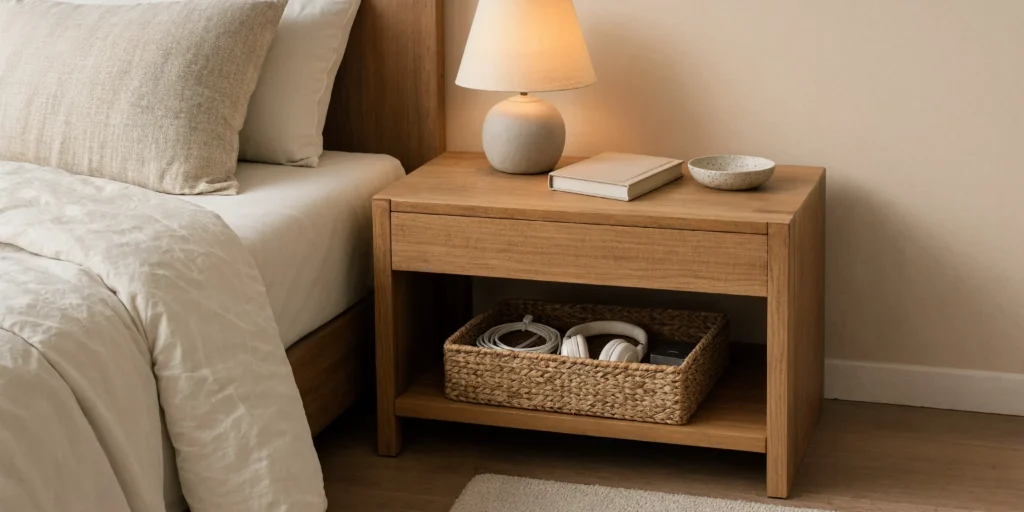
What If Your Nightstand Has an Open Shelf?
Open shelving is useful, but it can easily become visually noisy.
Instead of placing individual objects across the shelf, create one or two contained groups.
For example:
Shelf Group 1
A small basket containing:
- Charging cables
- Remotes
- Headphones
Shelf Group 2
A small stack of books or magazines.
This gives the shelf a purpose without turning it into another display surface.
If everything is loose, the eye has to process every individual object.
If several things are contained together, the shelf reads as a much simpler composition.
The Five-Minute Nightstand Reset
Here’s a simple routine you can use when the surface starts getting messy.
You don’t need to completely redecorate it.
Set a timer for five minutes.
Minute 1 — Remove Everything That Doesn’t Belong
Take away cups, packaging, receipts, clothes, and anything that has migrated from another part of the room.
Minute 2 — Return the Essentials
Put back the things you actually use:
- Lamp
- Phone
- Glasses
- Current book
- Water
Only return what genuinely belongs there.
Minute 3 — Contain the Small Stuff
Put jewelry, earbuds, or other tiny objects into a tray or dish.
Minute 4 — Edit the Decoration
Look at what’s left.
If you have several decorative objects competing for attention, remove one.
Minute 5 — Look From the Bed
This final step is important.
Don’t judge the nightstand while standing directly in front of it.
Lie or sit where you normally use the bed.
Look across the room.
Does the bedside area feel calm?
Can you reach everything you need?
Does anything look unnecessarily large or out of place?
If yes, make one final adjustment.

The “Remove One Thing” Test
Sometimes you don’t need to know what’s wrong.
You just know the nightstand still feels too busy.
Try this:
Remove one object.
Then step back.
If the arrangement immediately feels better, you’ve found the problem.
This works because decoration isn’t only about what you add.
It’s also about what you leave out.
You might even discover that the object you removed wasn’t doing anything useful visually or practically.
Put it somewhere else.
If you don’t miss it, it probably didn’t need to be there.
Before and After: The Power of Editing
Imagine a small nightstand with:
- Large lamp
- Candle
- Vase
- Plant
- Three books
- Picture frame
- Jewelry
- Phone
- Water
- Charging cable
Every individual item could look beautiful.
Together, they’re competing for the same small piece of furniture.
Now edit it down to:
- Lamp
- Current book
- Small tray
- One personal object
- Phone
The bedroom hasn’t lost its personality.
It has gained breathing room.
That’s the difference between decorating a nightstand and styling one.

What to Do When the Bedside Area Is Asymmetrical
Not every bedroom has a perfectly symmetrical layout.
You might have:
- A window on one side
- A wall on the other
- A door close to one nightstand
- Different amounts of available space
- One side against a wall
- A radiator or heating unit nearby
Don’t try to force symmetry where the architecture doesn’t allow it.
Instead, aim for visual balance.
For example:
A larger lamp on one side might be balanced by artwork or a taller wall element on the other.
A large nightstand might be paired with a narrower one.
One side might have drawers while the other uses a simple table.
The goal is not to make both sides identical.
The goal is for the whole bed area to feel intentional.
If One Side of the Bed Has No Nightstand
That’s completely fine.
In a small bedroom, a traditional pair of nightstands can sometimes make the room feel unnecessarily crowded.
You could use:
- One nightstand
- A floating shelf
- A narrow pedestal table
- A wall-mounted lamp
- A small stool
- A compact bedside shelf
The important thing is providing the functions you actually need.
If you only need somewhere for a phone and a lamp, you may not need a full-size cabinet beside the bed.
This is especially useful in compact bedrooms, where keeping the floor area open can make the room feel more spacious.

When a Floating Nightstand Makes More Sense
Floating bedside tables can be particularly useful when you want to preserve visible floor space.
Because the furniture doesn’t extend all the way to the floor, the room can feel visually lighter.
They’re also useful for:
- Small bedrooms
- Narrow walkways
- Minimalist interiors
- Low-profile beds
- Modern bedrooms
But there’s a trade-off.
A floating shelf or drawer usually provides less storage than a conventional nightstand.
So before choosing one, ask:
Do I need storage—or just a surface?
If you only need a place for a lamp, phone, and glass of water, a simple floating surface may be enough.
If you keep several bedside essentials nearby, drawers may be more useful.
The Nightstand Shopping Test
Here’s something I want you to do before buying a new nightstand.
Don’t start with:
“Which one looks nicest?”
Start with:
Question 1
What do I need beside my bed every night?
Question 2
How much surface area do those things actually require?
Question 3
Do I need drawers, shelves, or neither?
Question 4
How much walking space must remain around the bed?
Question 5
Will the height work with my bed?
Only after answering those questions should you start looking at styles and finishes.
This prevents a common mistake: buying a beautiful nightstand that doesn’t actually work with your bedroom.

The Bedside Cable Shouldn’t Become the Decoration
We’ve already talked about charging cables, but there’s one more thing worth checking.
Look at the nightstand from the doorway.
That’s often the angle from which you’ll see the entire bedroom.
If the first thing your eye catches is a bundle of cables hanging over the side, the bedside area will feel unfinished no matter how beautiful the rest of the styling is.
Try to route cables:
- Behind furniture
- Along the rear edge
- Through a cable clip
- Into a nearby outlet with minimal visible slack
The goal isn’t perfection.
It’s simply to keep functional technology from becoming the visual centerpiece.
The Nightstand Should Match Your Routine, Not Someone Else’s Bedroom
This may be the most important part of the entire guide.
You don’t need to recreate a photograph from Pinterest.
You don’t need six decorative objects.
You don’t need a marble tray, designer lamp, coffee-table book, vase, candle, and sculpture just because they look good together in a photograph.
If you read every night, keep a book.
If you don’t, don’t display books just for decoration.
If you drink water before bed, make room for it.
If you charge your phone beside the bed, plan for the cable.
If you prefer an empty surface, let it be empty.
A well-styled nightstand should make your routine easier—not create another chore.

The DecorePantry Nightstand Test
Before you consider the bedside area finished, ask yourself these five questions:
1. Can I reach everything I need without getting out of bed?
If not, move the essentials.
2. Is there enough empty surface for everyday use?
If not, remove something.
3. Is one object visually dominating everything else?
If yes, reconsider its scale.
4. Are small items contained?
If not, introduce a tray, dish, drawer, or basket.
5. Does it still look good when the decorative extras are removed?
If yes, you’ve built the arrangement around function rather than decoration.
That’s the goal.
Frequently Asked Questions About Styling a Nightstand
What should you put on a nightstand?
Start with the things you genuinely use at night, such as a lamp, phone, reading glasses, a book, or water. Then add one or two decorative elements if there is enough room. A tray or small dish can keep loose items contained without making the surface feel crowded.
The exact combination should depend on your routine rather than a fixed list of accessories.
How many things should be on a nightstand?
There isn’t a magic number.
A better approach is to consider the visual weight of the objects and the amount of usable surface remaining.
A small nightstand might only need a lamp, book, and small dish. A wider table can accommodate more, provided there is still enough open space for everyday use.
If you can’t comfortably put your phone or glass of water down, you probably have too much on the surface.
Should nightstands match the bed?
They don’t have to match exactly.
The nightstand should relate to the bed through proportion, material, color, or visual weight.
A very delicate table beside a large upholstered bed may feel undersized, while an oversized cabinet can overpower a smaller bed.
Think about the entire bedside composition rather than matching furniture pieces simply because they were sold as a set.
Should both nightstands match each other?
Matching nightstands create symmetry and are an easy way to make a bedroom feel orderly.
But mismatched nightstands can work just as well when they have some visual connection.
Matching lamps, similar finishes, comparable heights, or similar visual weight can tie different tables together.
Mismatching can also be practical when the two people using the bed have different storage or bedside needs.
Should you put books on a nightstand?
Only if you actually read them.
A current book or a small stack of books can add height and personality, but books shouldn’t be added simply to fill empty space.
If you do use them for styling, keep the stack relatively small and place it where it won’t interfere with your lamp, phone, or other nighttime essentials.
Do you need a tray on a nightstand?
No, but a tray can be useful when several small objects tend to collect on the surface.
Instead of having jewelry, glasses, earbuds, and other small items scattered individually, a tray creates one defined landing area.
Choose a size that leaves enough usable surface around it.
A tray that occupies almost the entire nightstand defeats the purpose.
How do you style a very small nightstand?
Start with the most important function.
If you need a lamp, choose a compact lamp or consider wall-mounted lighting. Then leave room for one or two genuine essentials.
Avoid trying to recreate a large nightstand arrangement on a tiny surface.
Small furniture usually benefits from fewer, better-chosen objects.
How do you make a nightstand look less cluttered?
Remove anything you don’t use at night, move rarely used items into drawers, contain small objects in a tray or dish, and leave some of the surface empty.
Then look at the nightstand from the bed and from the doorway.
If one object immediately catches your attention because it is too large, too colorful, or surrounded by too many competing objects, edit the arrangement again.
A Beautiful Nightstand Should Still Work at Bedtime
The best nightstand isn’t necessarily the one with the most beautiful objects.
It’s the one you can actually use.
Your lamp should be easy to reach.
Your phone should have somewhere to land.
Your glasses shouldn’t disappear beneath a stack of decorations.
Your charger shouldn’t become the most noticeable feature in the room.
And there should be enough empty space that you don’t feel like you’re disturbing a carefully staged display every time you put something down.
That’s why the best bedside styling usually begins with function and ends with editing.
Start by clearing the surface.
Decide what belongs there.
Create room for the essentials.
Add height where it’s useful.
Introduce personality carefully.
Then remove one thing.
If the nightstand still feels complete after that final edit, you’re probably closer to the right arrangement.
A nightstand doesn’t need to look busy to look finished.
Sometimes the most beautiful bedside table is simply the one that makes the bedroom feel calmer when the lights go down.
Ready to Build the Rest of Your Bedroom?
A nightstand rarely exists in isolation. The way it looks is influenced by everything around the bed—from the rug underneath it to the artwork on the wall and the way the pillows are arranged.
If you’re continuing to refine your bedroom, you may also want to explore:
- How Many Pillows Should Be on a Bed? — for creating a balanced bed arrangement
- Bedroom Rug Size Guide — for choosing the right rug proportions around the bed
- How High Should You Hang Wall Art? — for getting the artwork around your bedside area right
As DecorePantry grows, we’ll continue adding practical guides that help you make those decisions room by room.