1. The Psychology of Reflection: Why Your Space Feels Small and How to Fix It
In the discipline of interior architecture, “spatial claustrophobia” is not merely a subjective feeling of being cramped; it is a direct result of the compression of the visual field caused by rigid boundaries and inadequate light distribution. When we encounter visual “stops”—solid walls, heavy furniture, or dark corners—the brain registers a lack of volumetric potential. As a Senior Interior Architect, I treat a mirror not as a secondary accessory, but as a primary structural tool. It is a portal for specular reflection that allows us to manipulate the perceived square footage of a room without an invasive structural overhaul.
A frequent oversight in residential design is the reliance on “boxy,” rectilinear decor in constrained floor plans. This reinforces the existing perimeter, making the space feel static. The strategic integration of minimalist mirrors provides a definitive cure. By using high-transparency glass to capture and redirect light, we can double the visual horizon, effectively neutralizing the psychological weight of load-bearing walls. This spatial expansion is not just about aesthetics; it is about maximizing lux levels and creating a sense of relief through the manipulation of light and depth.
2. Breaking the Box: Using Organic Forms in the Modern Living Area
The living room serves as the structural anchor for a home’s flow. To establish an “open-concept” feel, we must mitigate the rigid lines of traditional sofas, cabinetry, and shelving. While a standard rectangular mirror merely mirrors the “box” of the room, organic forms like an Asymmetrical Scalloped Mirror or an Irregular Round Mirror introduce a sense of architectural fluidity.
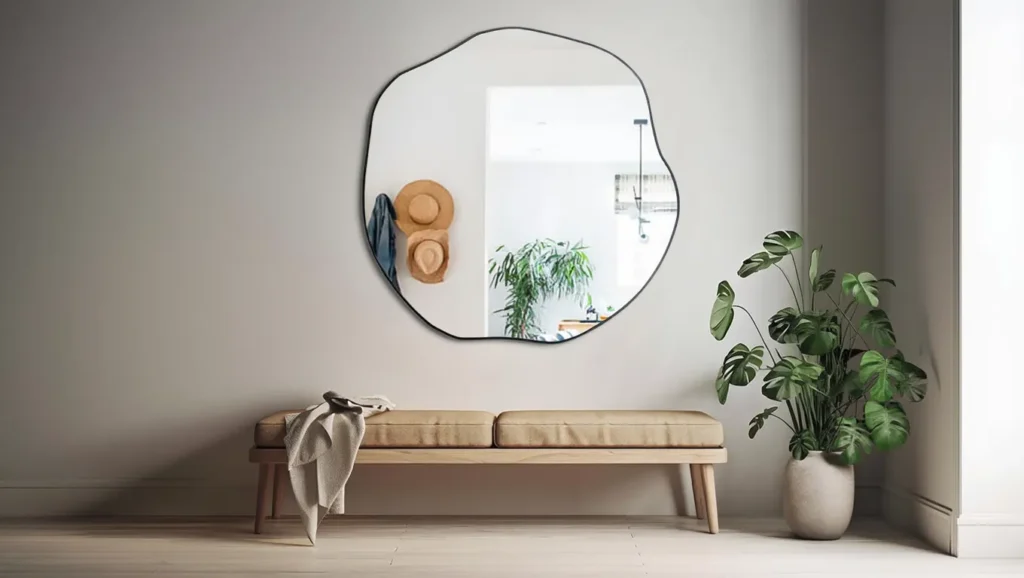
View details for: Large Asymmetrical Circle Mirrors.
As a spatial strategist, I recommend utilizing the versatile mounting capabilities of these irregular forms. The Asymmetrical Scalloped Mirror, for instance, can be hung in four unique orientations. By orienting the mirror vertically, you draw the eye upward to suggest ceiling height; a horizontal placement expands the perceived width of the room; and a “playful” diagonal angle creates a dynamic focal point that breaks visual monotony. When specifying minimalist mirrors for living room use, position them above consoles or fireplaces to act as “internal windows.” By reflecting external greenery or art from an opposing wall, these minimalist mirrors create a layered effect that suggests the environment continues indefinitely beyond the drywall.
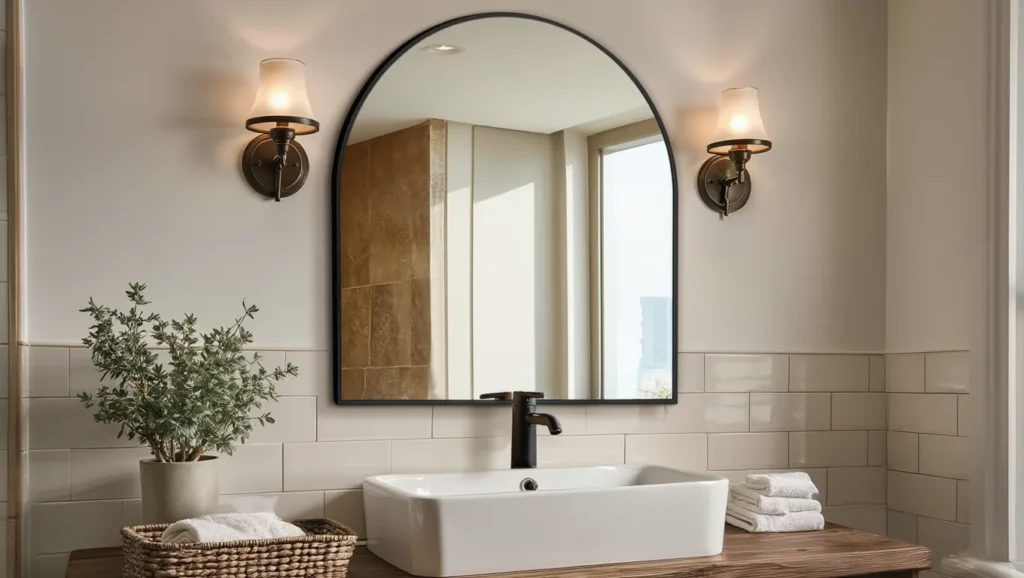
View details for: Arched Bathroom Mirror.
3. The Illumination Equation: Elevating the Bathroom Sanctuary
In a bathroom, the design mandate shifts to “precision meets peace.” Here, the goal is to transform a utility-driven space into a high-end sanctuary through the use of high-definition clarity and advanced lighting. The traditional vanity setup often fails by creating harsh shadows, but an Irregular LED Backlit Mirror solves this by providing shadow-free “aura” lighting. Technically, this backlighting creates a plane separation between the mirror and the wall, resulting in a three-dimensional “floating” effect that adds depth to even the most compact powder rooms.
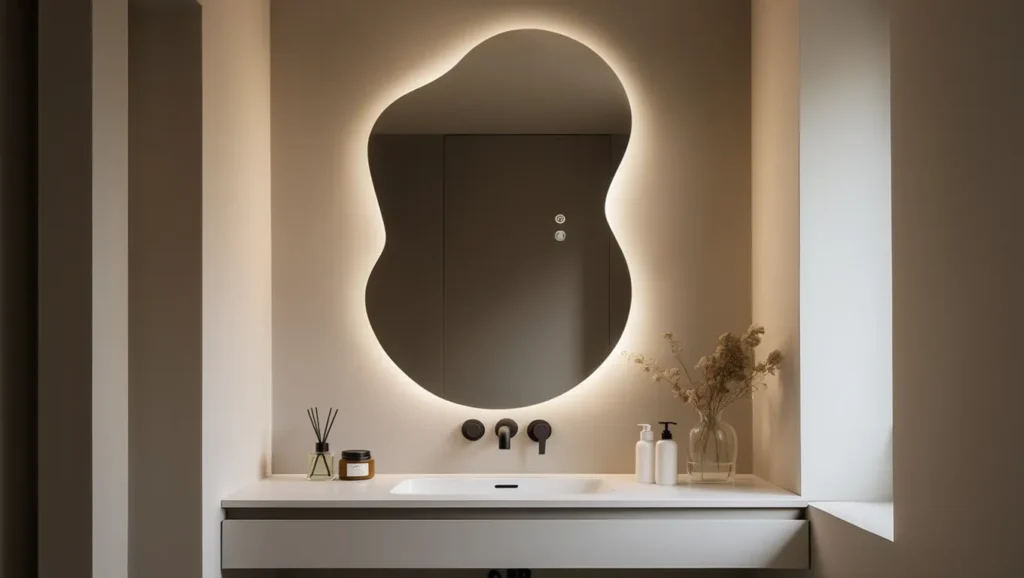
View details for: Irregular LED Bathroom Mirror.
Materiality in high-humidity zones is equally critical. While a Walnut Wood Grain Framed Mirror offers the grounded warmth of a farmhouse aesthetic, we specify frames made from high-grade Polystyrene (PS). This material provides the rich visual texture of walnut with the moisture-resistant durability of a polymer, ensuring the frame will not warp or rot in a vapor-heavy bathroom. For a more modern silhouette, an Arched Black Framed Mirror provides an architectural “crown” to the vanity. Regardless of style, minimalist mirrors for bathroom applications should follow the “eye-level” rule, utilizing anti-rust and anti-corrosion materials to ensure long-term clarity in a functional spa environment.
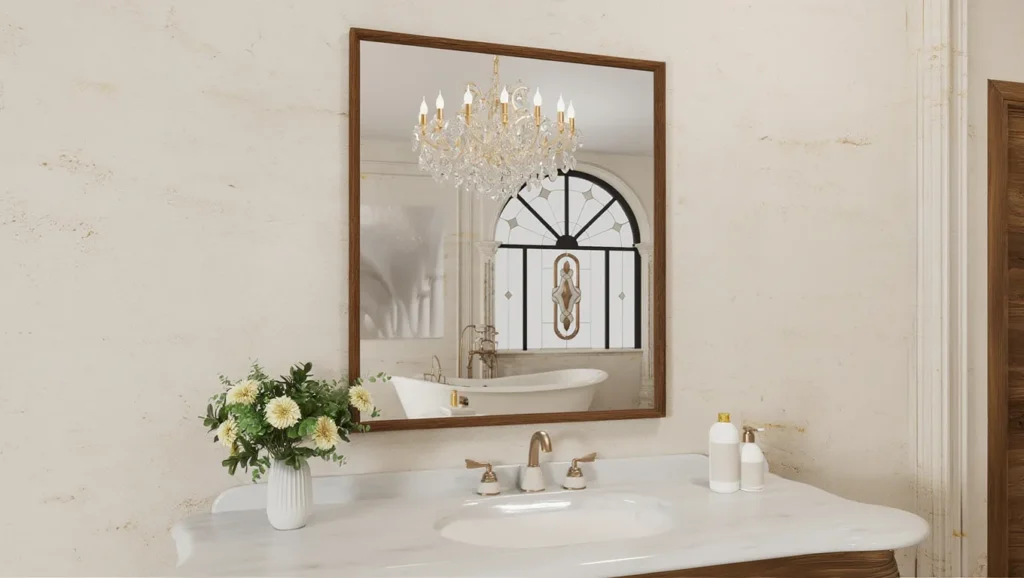
View details for: Wood Grain Framed Mirror.
4. The Infinite Corridor: Mastering the Full Length Mirror
Architectural verticality is the most potent tool for suggesting grandeur. A Full length Mirror serves as a vertical anchor, pulling the gaze upward and visually elevating the ceiling height. In the bedroom, the choice between a leaning or mounted installation significantly alters the room’s light profile. A Frameless Full Length Silver Coating Mirror leaned against a wall provides a minimalist, specular efficiency that feels effortless. Conversely, an Oversized Arched Full Length Mirror makes a structural statement, acting as a permanent architectural fixture.
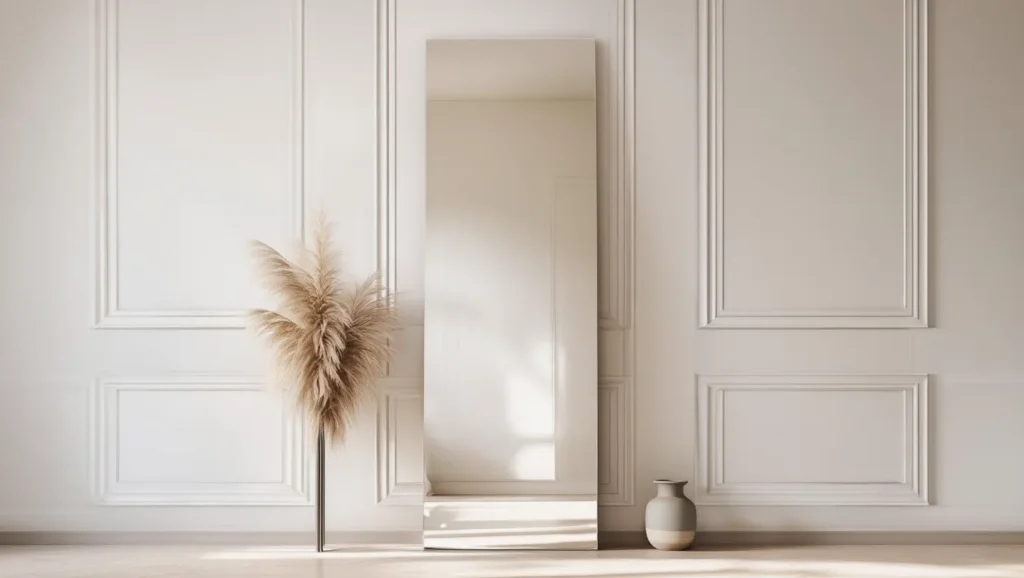
View details for: Frameless Full Length Silver Coating Mirror.
When selecting minimalist mirrors for bedroom use, I employ the “golden hour” strategy. Positioning a Minimalist Mirror Full Length directly opposite a window allows it to capture the warmth of the setting sun and distribute it across the floor plan. This reduces the requirement for artificial light and connects the interior volume to the natural world outside. This simple placement logic transforms a standard dressing utility into a vehicle for spatial health and natural illumination.
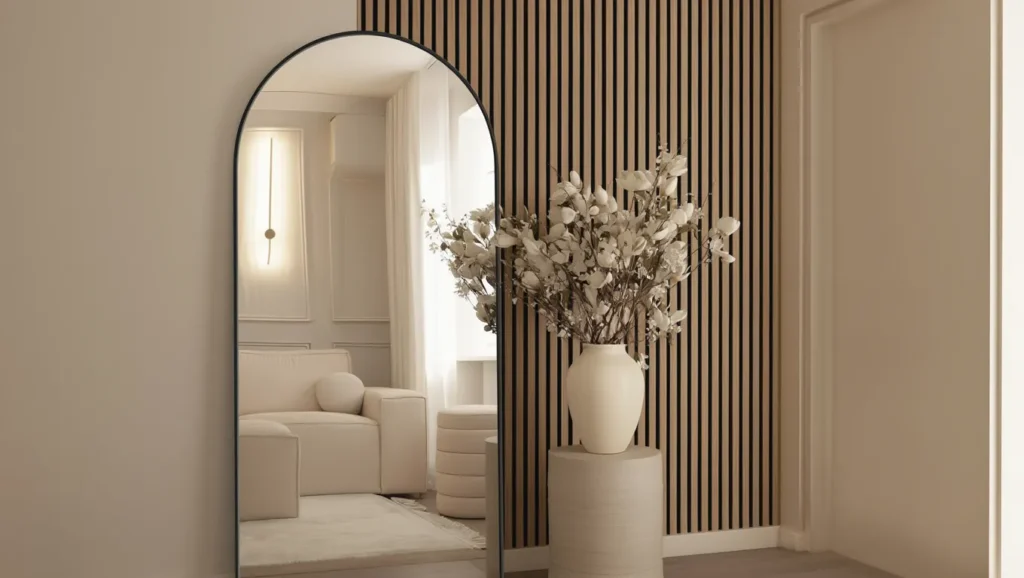
View details for: Arched Full Length Mirror.
5. Technical Integrity: Choosing Quality Over “Funhouse” Effects
From an architectural standpoint, the technical specifications of a mirror—the “unseen” elements—are what guarantee long-term spatial success. Cheap glass is a liability; it introduces visual noise through distortion, which actually shrinks a space by confusing the eye’s depth perception. Professional-grade expansion requires HD float glass with a 1:1 imaging ratio and a high-purity silver coating.
We prioritize 4mm tempered glass with anti-desilvering properties to prevent black spots and oxidation over time. The structural integrity of the glass is paramount: our standard for impact resistance is the ability to withstand 90 MPa of stress. To put this in perspective, this glass can endure a 22 lb iron ball dropped from a height of 40 inches without fracturing. For high-traffic areas, a shatterproof film is non-negotiable. This explosion-proof layer ensures that in the rare event of a break, the glass remains contained on the film rather than scattering into hazardous fragments. This technical rigor is the bridge between a mere decorative object and a safe, permanent architectural intervention.
6. Conclusion: The Final Reflection on Minimalist Living
The selection of a mirror is a calculated design decision that impacts the fundamental energy of a home. By moving beyond simple utility and considering the nuances of shape, light capture, and structural safety, you can effectively reconfigure your living environment. Whether you are using an asymmetrical form to soften a rigid living area or a vertical anchor to expand a corridor, the right mirror is an intervention that changes the very nature of your space.
By prioritizing high-integrity materials like 4mm tempered glass and moisture-resistant PS frames, you ensure that your home remains a sanctuary. A commitment to quality is what transforms a house from a collection of “stops” into an expansive, light-filled haven of minimalist beauty.