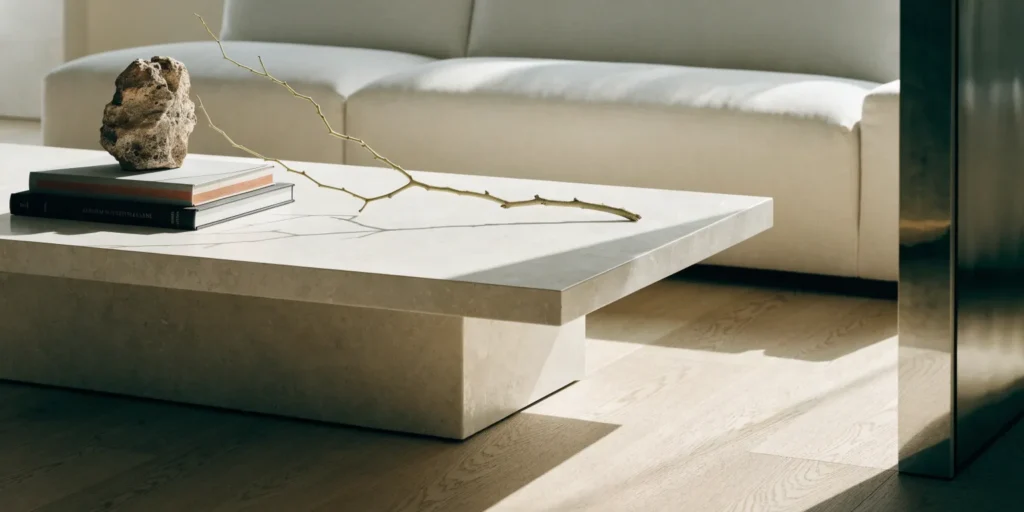
How to Style a Minimalist Coffee Table (Without It Looking Empty)
A minimalist coffee table should not be empty—it should look intentionally edited.
The easiest way to get the balance right is to use four ingredients:
one visual anchor + one change in height + one organic element + plenty of open surface.
That might mean two beautiful books topped with a small ceramic object, paired with a low vase and a simple tray. Or it could be nothing more than one sculptural bowl and a branch in a vase.
The secret isn’t adding more decor.
It’s giving fewer objects enough space to matter.
That’s the difference between a coffee table that looks unfinished and one that feels calm, expensive, and thoughtfully styled.
At DecorePantry, we use a simple framework:
Anchor → Height → Life → Space
We’ll show you exactly how it works.
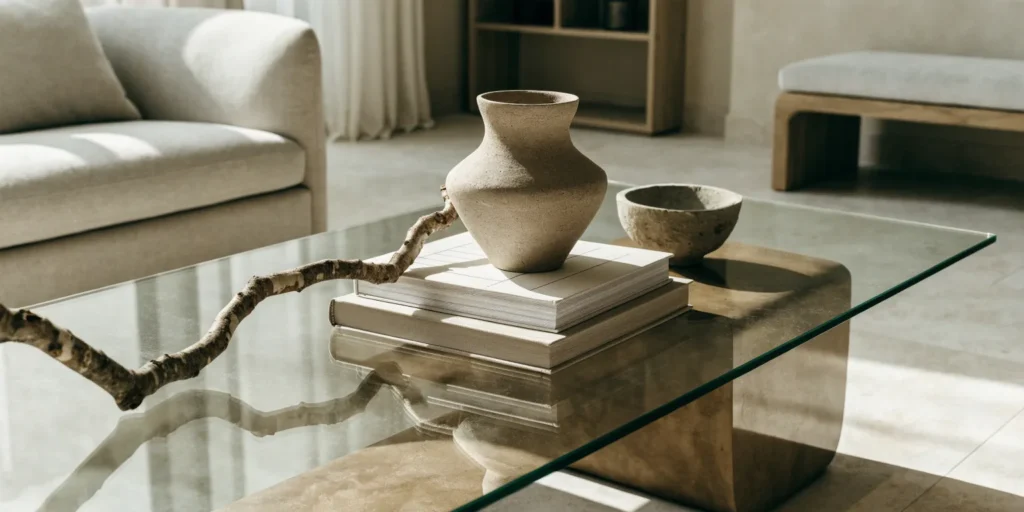
Why Does a Minimalist Coffee Table Sometimes Look Empty?
This is where minimalist decorating often goes wrong.
You remove the clutter.
You hide the remotes.
You take away the random candles, coasters, magazines, bowls, and decorative objects.
And suddenly the coffee table looks…
unfinished.
The problem isn’t necessarily that you’ve removed too much.
It’s that whatever remains doesn’t create enough visual structure.
Imagine a large rectangular coffee table with one tiny candle in the center.
Technically, it’s minimalist.
Visually, however, the candle has no relationship with the scale of the table.
Now imagine that same table with:
- two stacked books,
- a small handmade bowl,
- and one simple vase.
The surface is still mostly empty.
But the objects form a composition.
That’s what we’re trying to achieve.
Minimalism works when the emptiness around objects feels intentional rather than accidental.
Designers frequently emphasize this role of negative space. Architectural Digest, for example, notes that blank space gives decorative objects room to breathe instead of allowing every available surface to become visually crowded.

The DecorePantry Coffee Table Formula
Before buying anything, remember these four words:
Anchor → Height → Life → Space
You don’t need every trendy coffee-table accessory.
You need a few objects that perform different visual jobs.
Anchor
Something visually substantial that establishes the arrangement.
Examples:
- coffee table books
- a tray
- a large bowl
- a sculptural object
Height
Something that changes the vertical level of the composition.
Examples:
- a vase
- candle
- small lamp
- sculptural vessel
Life
Something organic or irregular that prevents the arrangement from feeling sterile.
Examples:
- a branch
- flowers
- greenery
- natural stone
- handmade ceramic
Space
The uncovered part of your coffee table.
This fourth ingredient is the one people often forget.
House Beautiful’s 2026 designer guidance similarly recommends combinations such as a tray, books, an organic element, and one or two decorative pieces—while deliberately retaining usable open surface.
Let’s build the table step by step.

1. Start With the Coffee Table, Not the Accessories
Before styling the surface, look at the table itself.
Ask:
- Is it round or rectangular?
- Light or dark?
- Solid or transparent?
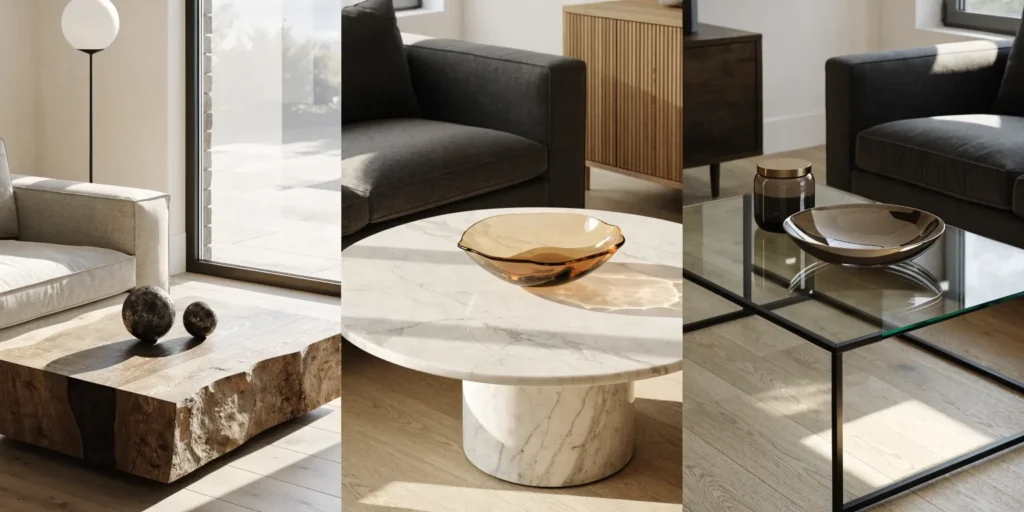
- Wood, glass, stone, or metal?
- Large or compact?
- Visually heavy or delicate?
Your decor should complement the table—not completely hide it.
A beautiful travertine table, for example, already provides texture and visual interest. Covering most of it with books, trays, candles, and accessories defeats the point.
A simple wood table may benefit from a little more contrast.
A glass table already feels visually light, so carefully chosen objects can give it needed weight.
Minimalist styling becomes easier when you treat the table itself as part of the decoration.
DecorePantry Rule
The more visually interesting the table, the less decor it usually needs.
2. Choose One Anchor
Every arrangement needs something that tells your eye:
Start here.
That’s your anchor.
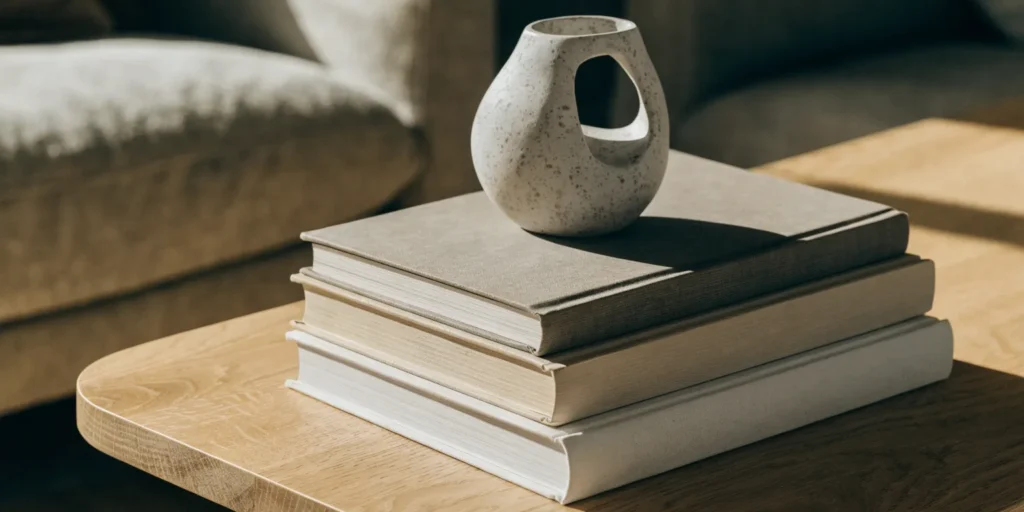
For most coffee tables, the easiest anchors are either a small stack of books or a tray.
Option A: Coffee Table Books
Use one to three substantial books rather than a pile of random thin books.
Books work especially well because they provide:
- width,
- color,
- height,
- and a platform for another object.
They also make the room feel personal when their subjects genuinely relate to you—architecture, fashion, cars, travel, photography, art, gardens, or whatever you actually enjoy.
Books are regularly recommended by interior stylists because they can ground an arrangement while revealing something about the homeowner’s interests.
Don’t buy books purely because the covers match your sofa.
A minimalist home feels far more interesting when the few things on display have a reason to be there.
Option B: A Tray
A tray is especially useful if your coffee table naturally collects:
- remotes,
- coasters,
- reading glasses,
- candles,
- small objects.
Instead of spreading those items across the entire table, a tray creates one visual boundary.
Suddenly, several small items read as one composition.
Current designer advice describes trays in exactly this role: creating hierarchy, controlling visual clutter, and grouping objects into an intentional vignette.
But here’s the mistake:
Don’t choose a tiny tray and cram it with tiny objects.
The tray should feel proportional to the table and still have some empty area inside it.
Minimalism needs breathing room even within the arrangement.

3. Create Different Heights
Place three objects of exactly the same height together and they often feel flat.
Change their heights and suddenly the arrangement has rhythm.
You don’t need dramatic differences.
Think:
low → medium → high
For example:
Low:
coffee table books
Medium:
a ceramic bowl
High:
a small vase with a branch
Your eye naturally moves between them.
Designer coffee-table guidance often recommends varying heights and shapes rather than filling the surface with objects at one uniform level.
Keep the Tallest Object Reasonable
Remember that people are sitting around this table.
Your arrangement shouldn’t become a visual wall between opposite sides of the sofa.
A delicate branch or transparent vase can go taller because it still feels visually light.
A massive opaque arrangement is different.
Your coffee table is part sculpture, part working surface.
It needs to do both jobs.
4. Add One Organic Element
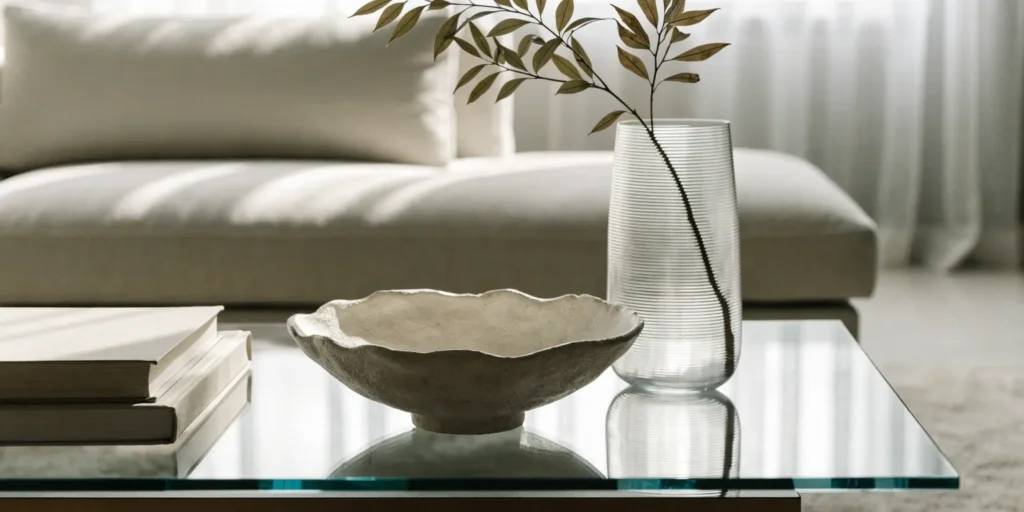
This may be the easiest way to stop minimalist decor from looking cold.
Add something imperfect.
A branch.
A handful of flowers.
A small plant.
A handmade ceramic vessel.
A piece of stone.
A wooden object with visible grain.
Why does it work?
Because minimalist furniture often relies heavily on clean geometry:
rectangular sofas,
straight tables,
smooth walls,
simple shelving.
An organic shape interrupts all of those straight lines.
That little bit of irregularity gives the room life.
Architectural Digest has likewise recommended flowers, plants, decorative vessels, and personal natural elements as effective coffee-table focal points.
You Don’t Need a Giant Bouquet
For a minimalist look, try:
- one leafy branch,
- three small stems,
- a sculptural dried stem,
- or a simple empty vase with an interesting silhouette.
Sometimes one branch has more presence than twenty flowers.

5. Use the Rule of Three—But Don’t Treat It Like a Law
You’ve probably heard that objects look good in groups of three.
They often do.
Three creates asymmetry without becoming chaotic.
For example:
- stack of books,
- vase,
- decorative bowl.
Done.
But don’t start counting every object on your table.
A stack of three books can visually behave like one object.
A tray containing several items can also behave as one larger visual unit.
The useful idea isn’t really “three objects.”
It’s three visual masses.
That distinction makes styling much easier.
Example
Instead of scattering:
candle + remote + bowl + three books + vase + coasters + sculpture
across the table, create:
Mass 1: books + small sculpture
Mass 2: vase
Mass 3: tray + useful items
Now your eye sees an arrangement instead of clutter.

6. Don’t Put Everything in the Center
This is one of the easiest mistakes to spot.
You buy a vase.
You put it directly in the middle.
Then perhaps a candle beside it.
Then everything slowly gathers around the center like it’s being pulled into orbit.
Instead, try asymmetrical balance.
Shift your main arrangement slightly off-center.
Leave another portion of the table mostly open.
Designer Laura Medicus, quoted by House Beautiful, specifically advises against simply dropping every decorative object into the middle of the table.
Why does off-center styling work?
Because the empty portion becomes part of the composition.
It also gives you somewhere to actually put a coffee cup.
Which brings us to the most important minimalist accessory of all.
Nothing.

7. Treat Empty Space as Decor
Minimalist styling isn’t about asking:
“What else can I add?”
It’s about knowing when to stop.
One designer quoted by Architectural Digest describes negative space as being as important as the objects themselves because it allows decor to breathe.
That’s particularly important on a coffee table because the table has a real function.
You should still have room to:
- set down drinks,
- place snacks,
- open a book,
- use a laptop briefly,
- play a game,
- or simply put your feet up if that’s how your living room works.
A coffee table that looks amazing but can’t accommodate a mug has been styled for a photograph rather than for a home.
House Beautiful’s 2026 coffee-table feature makes the same practical point: leaving room for drinks and everyday use is part of good styling, not a failure to decorate enough.
The DecorePantry 50% Test
As a starting point—not a rigid formula—try leaving around half of the tabletop visually quiet.
You can adjust from there depending on the table.
The goal is simply to make empty space obvious and intentional.
8. Mix Shapes Instead of Adding More Objects
If your arrangement seems boring, your first instinct may be to add another accessory.
Try changing the shapes instead.
Suppose you have:
rectangular table + rectangular books + rectangular tray.
Everything follows the same geometry.
Add a round bowl.
Instant contrast.
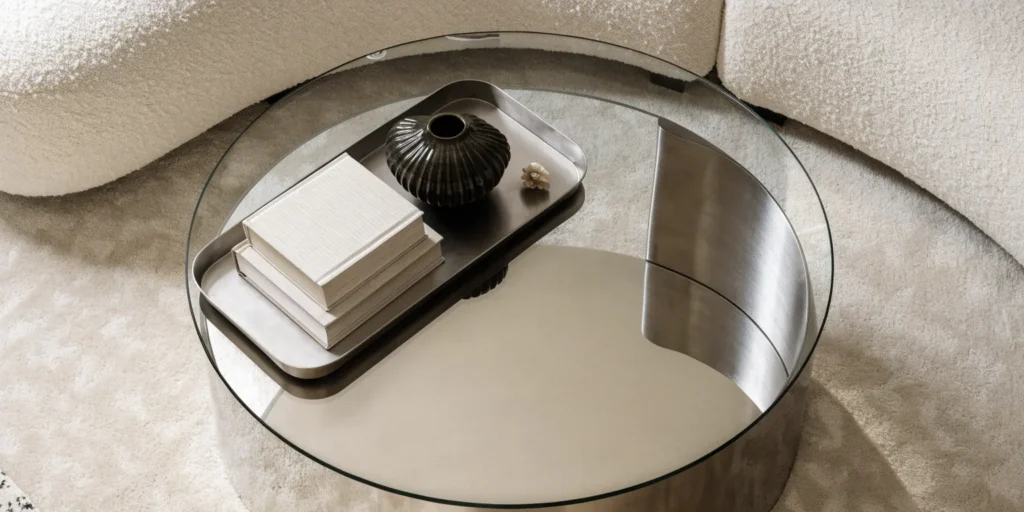
For a round coffee table, introduce something with stronger lines:
- rectangular books,
- a square box,
- an angular sculpture.
You can create more visual interest with three differently shaped objects than with eight similar ones.
This is one of the easiest ways to keep minimalist decor interesting without increasing clutter.
9. Add Texture Before Adding Color
When a neutral minimalist table feels lifeless, people often assume it needs color.
Sometimes it actually needs texture.
Compare:
white ceramic
smooth white book
white candle
white tray
with:
matte ceramic
linen-covered book
veined stone bowl
natural wood tray
The palette can remain almost identical.
Yet the second arrangement has significantly more depth.
Texture becomes especially important in restrained interiors because subtle differences in surfaces keep neutral rooms from appearing flat.
Try combining two or three materials such as:
- ceramic,
- stone,
- wood,
- glass,
- linen,
- metal,
- woven fiber.
Current interiors coverage similarly emphasizes material variation and texture as a way to add depth without abandoning a restrained palette.

10. Hide the Everyday Clutter
Minimalism gets much easier when your remote control has somewhere to live.
The real coffee-table enemies aren’t books or vases.
They’re usually:
- three remotes,
- charging cables,
- receipts,
- tissues,
- keys,
- loose coasters,
- game controllers.
These small objects create more visual noise than one substantial decorative piece.
Use:
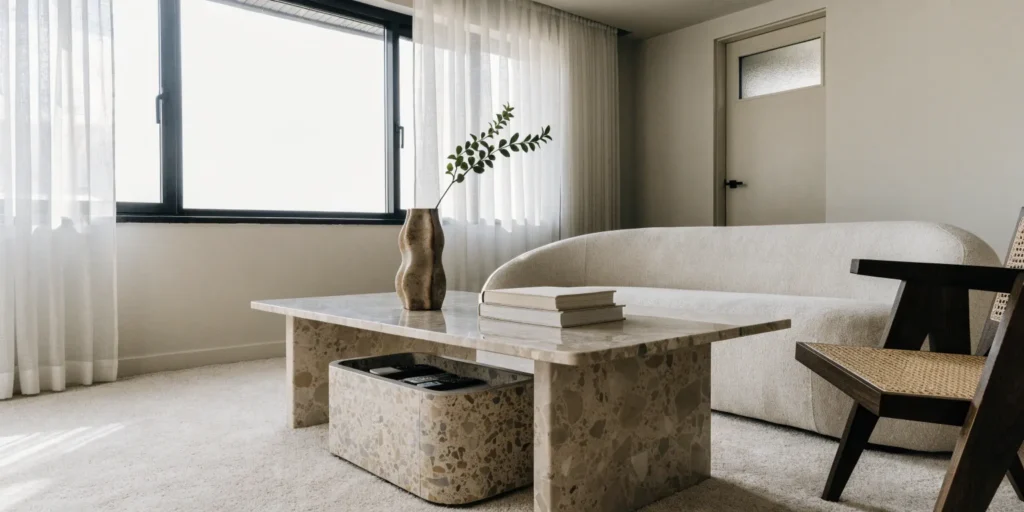
- a lidded decorative box,
- drawer,
- built-in storage,
- basket underneath,
- or tray.
Architectural Digest notes that coffee tables with drawers or hidden compartments are useful precisely because everyday essentials can remain accessible without dominating the tabletop.
The goal isn’t to pretend you don’t own a remote.
It’s to give the remote a home.
11. Add Something Personal
Minimalism can become generic surprisingly quickly.
Beige book.
Beige vase.
Beige candle.
Beige bowl.
Beautiful?
Possibly.
Memorable?
Not necessarily.
Give your arrangement one object that couldn’t simply have been copied from a showroom.
Maybe it’s:
- a book from a place you visited,
- a handmade ceramic piece,
- a family object,
- an unusual flea-market find,
- a small sculpture,
- shells collected on a trip,
- or something connected to a hobby.
Designers interviewed by House Beautiful make the same distinction between filling a surface with newly purchased accessories and choosing fewer objects with personal meaning.
Minimalism becomes warmer when objects aren’t just decorative.
They tell something about you.
12. Match the Arrangement to the Shape of Your Table
Rectangular Coffee Table
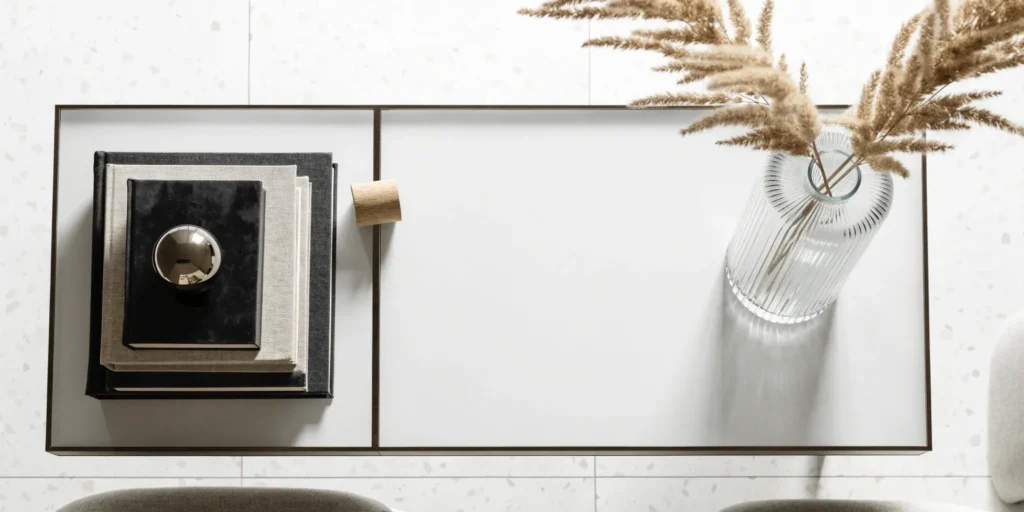
Instead of styling the entire length evenly, create two or three loose zones.
For example:
Left: books + decorative object
Center: empty space
Right: vase
This prevents the surface from becoming one long row of accessories.
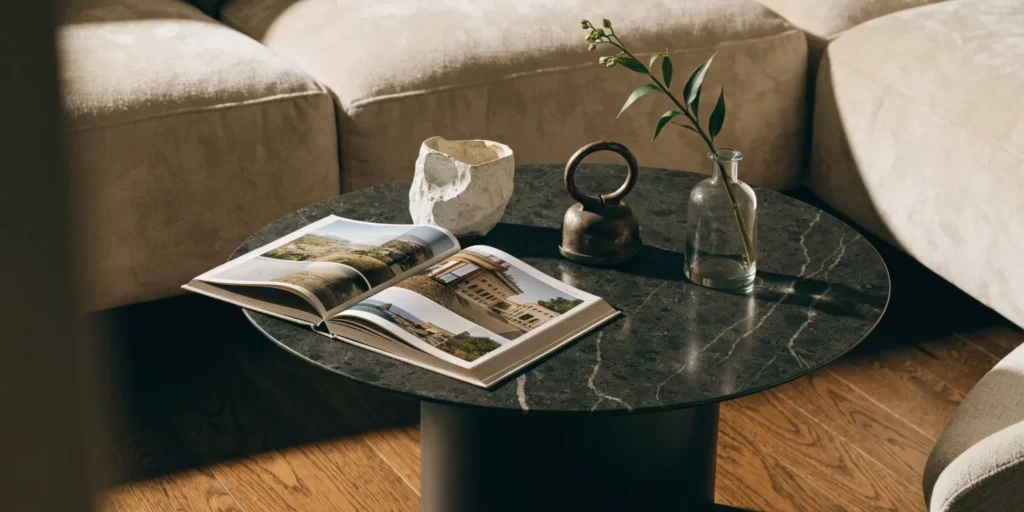
Round Coffee Table
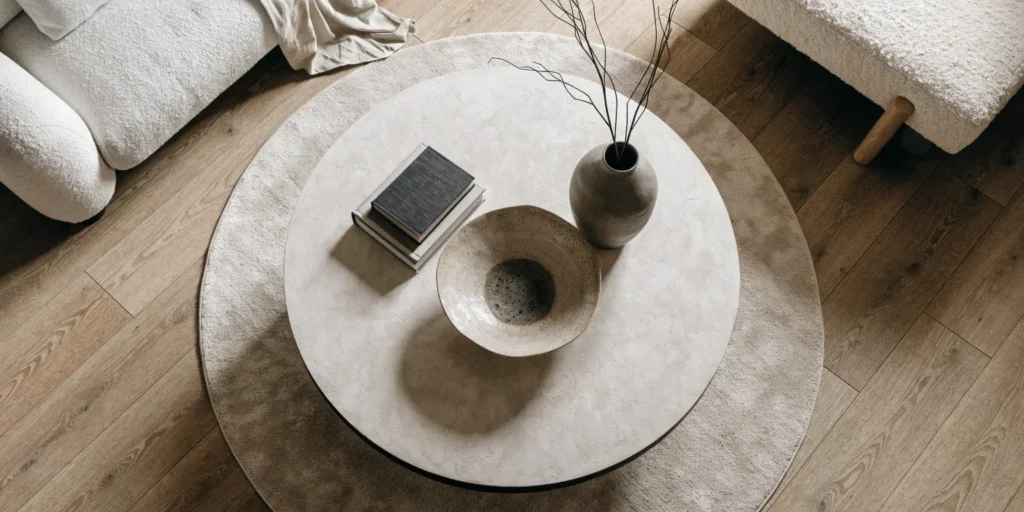
Avoid creating a straight line across it.
A loose triangular composition works particularly well:
- books,
- bowl,
- vase.
You can also use a round tray to reinforce the table’s shape; Architectural Digest has specifically recommended pairing round tables with round trays.
Small Coffee Table
Don’t shrink five accessories until they fit.
Use fewer pieces.
A simple combination could be:
- one book,
- one bowl,
- one tall object.
Recent guidance for small coffee tables similarly focuses on containment, a small amount of literature, and one piece providing height rather than filling every available inch.

Three Minimalist Coffee Table Formulas You Can Copy
Still unsure where to start?
Use one of these.
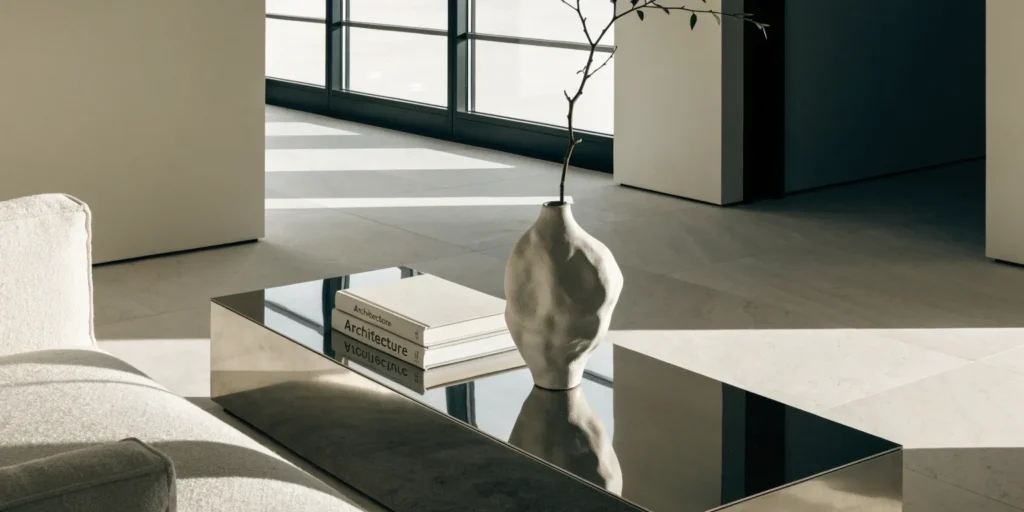
Formula 1: The Ultra-Minimal Table
1 vase + 1 branch + 2 stacked books
Best for:
- sculptural tables,
- contemporary homes,
- very clean interiors
Formula 2: The Warm Minimal Table
2 books + ceramic bowl + candle + natural branch
Best for:
- neutral living rooms,
- wood furniture,
- organic-modern interiors.

Formula 3: The Practical Minimal Table
1 tray + small vase + decorative box + coasters
Put the remote inside the box.
Now the table looks styled but remains useful.

The Mistakes That Make Minimalist Coffee Tables Look Wrong
Before you finish, check for these.
Everything is tiny
Five small accessories usually create more clutter than two substantial pieces.
Fix: Increase scale and reduce quantity.
Everything is the same height
The arrangement becomes flat.
Fix: Add one taller element.
Everything matches perfectly
Matching vase, tray, candleholder, and bowl sets can look more staged than curated.
Fix: Mix materials while keeping the palette connected.
There’s no personality
Your table resembles a furniture showroom.
Fix: Include one meaningful object.
There’s no usable surface
You’ve crossed from styling into storage.
Fix: Remove one group of objects.
The table is almost completely empty
Minimalism has become absence.
Fix: Introduce one visual anchor with enough scale to relate to the table.

The 5-Minute Coffee Table Reset
Already have everything you need?
Try this before buying anything.
Step 1
Remove every object from the coffee table.
Step 2
Put back your largest or most meaningful object.
Step 3
Add something with a different height.
Step 4
Introduce one organic or textural element.
Step 5
Stop.
Walk across the room and look back at the table.
Don’t ask:
“Is there enough stuff?”
Ask:
“Does anything else actually improve this?”
If the answer is no, you’re finished.

Final Thought: Minimalism Is Not About Having Less to Look At
It’s about giving your eye fewer things worth looking at.
That’s why an empty coffee table doesn’t automatically feel minimalist.
And a table with several objects doesn’t automatically feel cluttered.
What matters is the relationship between them.
Remember the DecorePantry formula:
Anchor → Height → Life → Space.
Choose one piece to ground the arrangement.
Change the height.
Introduce something organic or tactile.
Then leave enough empty surface around everything for the table—and the objects—to breathe.
When you’re tempted to add another candle, another book, another sculpture or another bowl, try removing something first.
Because the best minimalist coffee tables don’t make you wonder what is missing.
They make you feel that nothing else is needed.