Why Your Bedroom Still Feels Cluttered Even When It Is Clean
You have cleaned the bedroom.
The floor is clear. The clothes are put away. The bed is made. Nothing is obviously out of place.
But when you look around, the room still does not feel calm.
Something feels busy.
This can be confusing because we usually think of clutter as a cleaning problem. If everything is put away, the room should look tidy.
But a bedroom can be clean without feeling visually calm.
Visual clutter is not always about dirt, mess, or the number of things you own. It can also come from too many objects competing for attention, busy patterns, heavy furniture, crowded surfaces, or a room without a clear visual focus. Experts describe visual clutter as something that can make a space feel disorganized even when the individual items are neatly arranged.
That is good news.
It means you may not need to throw away half of your bedroom or buy a completely new furniture set.
Sometimes, the room simply needs better visual editing.
In this guide, we will look at the less obvious reasons a clean bedroom can still feel cluttered and what you can change without making the room empty or boring.
First, Understand the Difference Between Clean and Visually Calm
A clean bedroom has one main quality:
Things are under control.
A visually calm bedroom has another:
Your eyes know where to look.
Imagine a dresser with everything neatly arranged.
There might be a lamp, a mirror, a tray, three small decorations, a candle, a plant, several framed photographs, a stack of books, and a few personal items.
Nothing is necessarily messy.
But your eyes have to process many separate objects at once.
Now imagine the same dresser with a lamp, one larger piece of decor, and a small tray for everyday items.
The dresser is still useful.
It is simply easier to understand at a glance.
That is the difference we are looking for.
You do not have to create a completely empty bedroom. The goal is to reduce the number of things competing for attention so the important parts of the room can stand out.
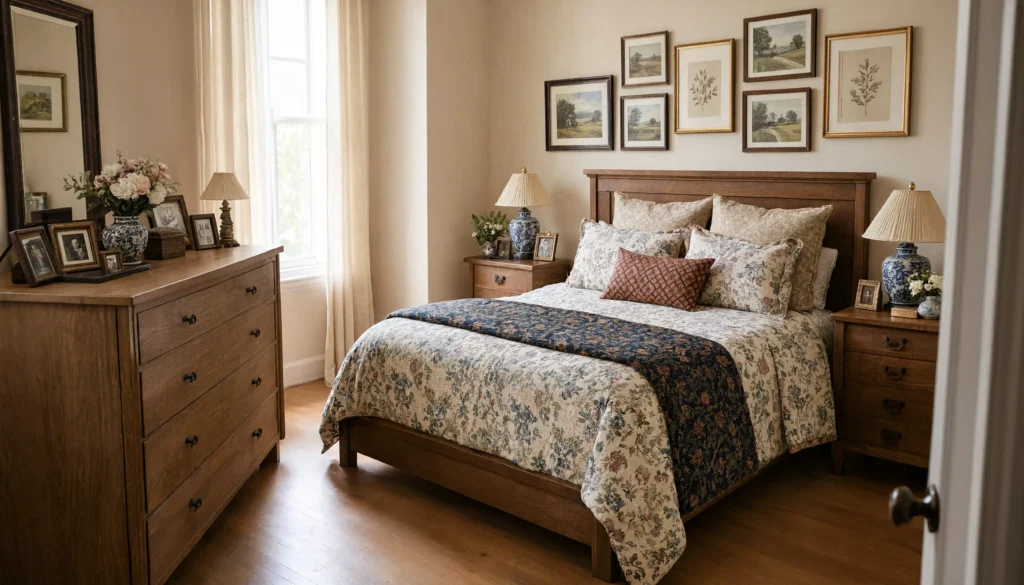
1. Too Many Small Things Are Competing for Attention
Small objects are easy to underestimate.
One small candle does not make a bedroom look crowded.
Neither does one small picture frame.
Neither does one little decorative bowl.
The problem appears when several of them collect in the same area.
A dresser may have ten small objects.
A nightstand may have six.
A shelf may contain another group.
Individually, they seem harmless. Together, they create many separate points for your eyes to notice.
This is one reason a room can look tidy but still feel busy.
Current design and organizing guidance repeatedly points to crowded surfaces and too many visible objects as common sources of visual clutter.
What to do instead
Choose which objects deserve to remain visible.
You might keep the lamp because you use it.
You might keep a framed photograph because it has personal meaning.
You might keep one decorative object because you genuinely like it.
But several small decorative items do not all need to compete for the same surface.
Try removing a few objects from one surface and look at it again.
Do not immediately replace the empty space.
Give your eyes a chance to see what the room looks like with less visual information.
This is not about following a strict rule such as “only three things per surface.”
Your bedroom is your bedroom.
The useful question is simply:
Does this surface feel intentional, or does every small object seem to ask for attention?
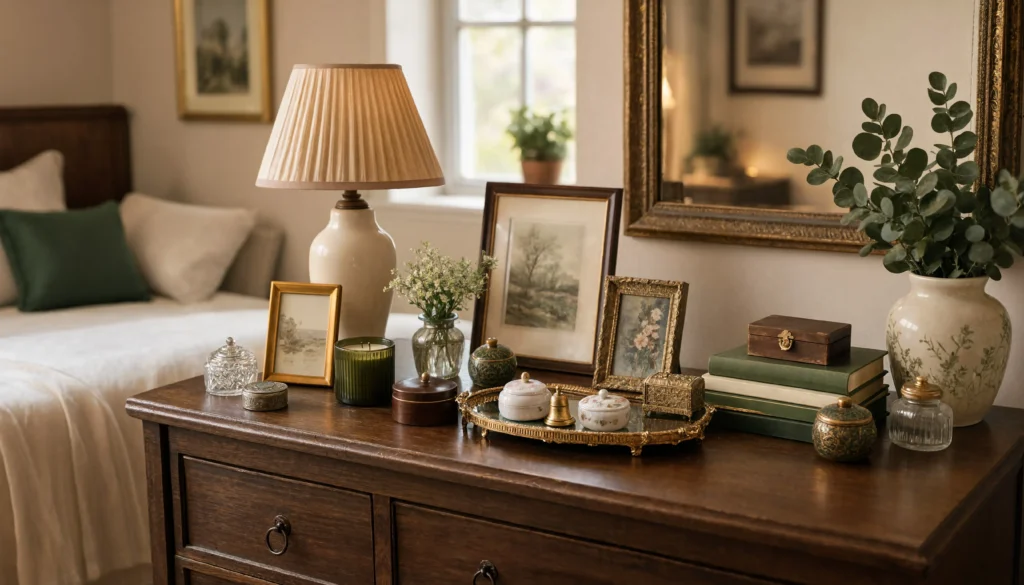
2. Your Bedding Has Too Many Competing Patterns
The bed is usually one of the largest visual areas in a bedroom.
That means what you put on it has a much bigger effect than a small decoration on a shelf.
A patterned duvet, patterned sheets, several different pillow designs, a printed throw, and a patterned rug can all look attractive on their own.
Together, they may make the room feel much busier.
The problem is not that patterns are bad.
The problem is when too many patterns compete instead of working together.
Design guidance for bedrooms commonly recommends using patterns thoughtfully and keeping their scale and overall palette connected so the room feels cohesive rather than chaotic.
What to do instead
Look at the bed as one complete composition.
If your duvet already has a strong pattern, consider using simpler sheets and pillows.
If the bedding is mostly plain, you can introduce pattern through one smaller element.
You also do not need every layer to have a different print.
For example, a simple neutral duvet can work with one patterned cushion or throw without making the whole bed visually loud.
The goal is not to remove personality.
It is to give the eye a place to rest.

3. The Furniture Is Visually Too Heavy for the Room
Sometimes a bedroom feels crowded even though there are not many pieces of furniture.
The problem can be the visual weight of those pieces.
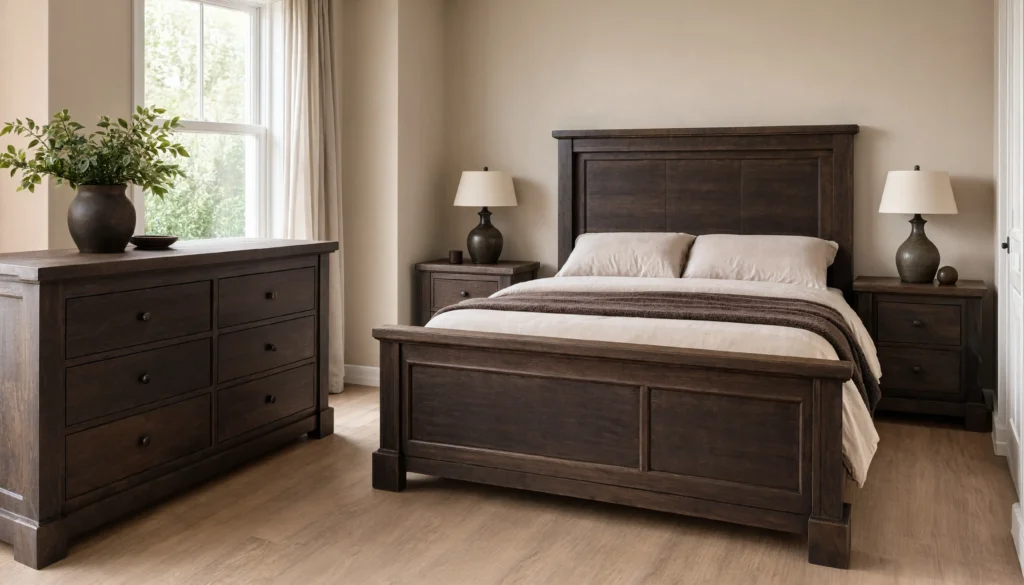
A large solid bed frame, a deep dresser, two heavy nightstands, and a bulky storage cabinet can make a room feel dense.
This can happen even when every piece technically fits.
The furniture is taking up physical space, but it is also taking up visual space.
Recent bedroom design guidance recommends lighter-looking furniture, slimmer proportions, and designs that allow more of the floor to remain visible when the goal is to make a small bedroom feel more open.
What to do instead
Look at the largest pieces first.
You do not necessarily need to replace them.
Sometimes a small change is enough.
A dresser with a lighter base can feel less heavy than one that sits completely on the floor.
A slimmer nightstand can provide the same basic function without looking as bulky.
A bed frame with visible space underneath can also allow more of the floor to remain visible.
The important point is this:
Do not measure furniture only by its width and depth. Look at how heavy it appears in the room.
Two pieces with similar measurements can create very different visual effects.
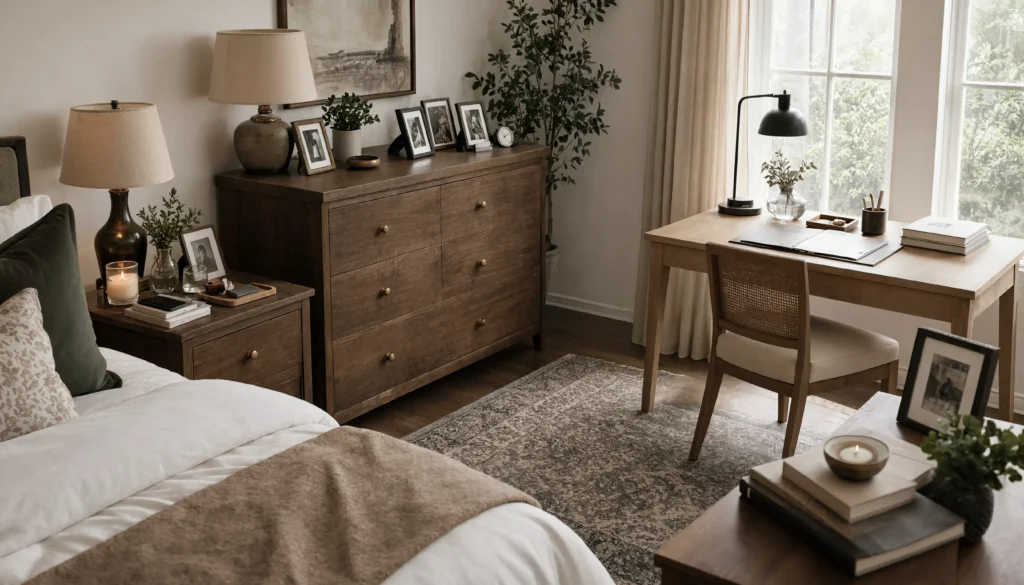
4. Every Surface Is Being Used
A clean bedroom can still feel crowded when every horizontal surface is occupied.
Look at your:
- nightstands
- dresser
- desk
- shelves
- window ledge
- storage cabinet
- bench
If each surface contains several objects, there may be nowhere for your eyes to rest.
This is especially noticeable in bedrooms because many of the objects are small: chargers, books, bottles, glasses, candles, jewelry, electronics, decorations, and personal items.
Even when each object has been placed neatly, the combined effect can be busy.
What to do instead
Choose a few surfaces that should remain useful and relatively clear.
Your nightstand, for example, may only need the things you actually use there.
Your dresser may need a lamp and a few personal objects rather than becoming a display for everything you like.
You do not have to clear every surface completely.
Instead, create some quiet areas between the busier ones.
This gives the room a better visual rhythm.
Think of it like a sentence.
If every word is bold, nothing feels important.
A bedroom works in much the same way.
5. Too Many Colors Are Breaking the Room Into Separate Pieces
Your bedroom does not have to be completely neutral to feel calm.
The problem usually starts when too many unrelated colors appear in different parts of the room.
For example, you might have blue bedding, a green chair, a yellow lamp, red artwork, brown furniture, and several colorful decorative objects.
Each item may look perfectly fine by itself.
But when you look at the entire room, your eye keeps jumping from one color to another.
Instead of seeing one bedroom, you start seeing many separate pieces.
A cohesive color palette helps the room feel more connected because fewer colors are competing for attention. Current interior guidance continues to emphasize that subtle, coordinated palettes can reduce visual noise without requiring a completely plain room.
What to do instead
You do not need to remove every color.
Start by choosing one main color that already exists in the room.
Then look for one or two supporting colors that work naturally with it.
For example, a bedroom with warm beige walls could use cream bedding, natural wood, and a muted green accent.
That does not mean every object needs to match.
It simply gives the room a common visual direction.
You can still keep a colorful photograph, a favorite cushion, or another personal item.
The difference is that the color becomes an accent instead of another competing voice.

6. There Is No Clear Focal Point
A bedroom can contain beautiful things and still feel confusing when nothing clearly leads the eye.
You walk into the room and see artwork on one wall, a large mirror on another, patterned bedding, several decorative shelves, a statement lamp, and a collection of objects on the dresser.
Which one are you supposed to notice first?
There is no obvious answer.
A room does not need to have one dramatic centerpiece, but it usually benefits from having one area that naturally attracts attention.
In a bedroom, that is often the bed or the wall behind it.
What to do instead
Choose one main feature.
It could be:
- the bed and headboard
- a simple artwork arrangement
- a textured wall behind the bed
- a window with attractive curtains
- one carefully chosen piece of furniture
Then allow the surrounding elements to support it instead of competing with it.
For example, if the wall behind the bed already has strong artwork, the dresser opposite it does not also need a large collection of decorative objects.
This is less about following a decorating rule and more about giving the eye a clear starting point.
When everything is trying to be the star, the room can feel noisy.
When one area leads and the others support it, the room becomes easier to read.

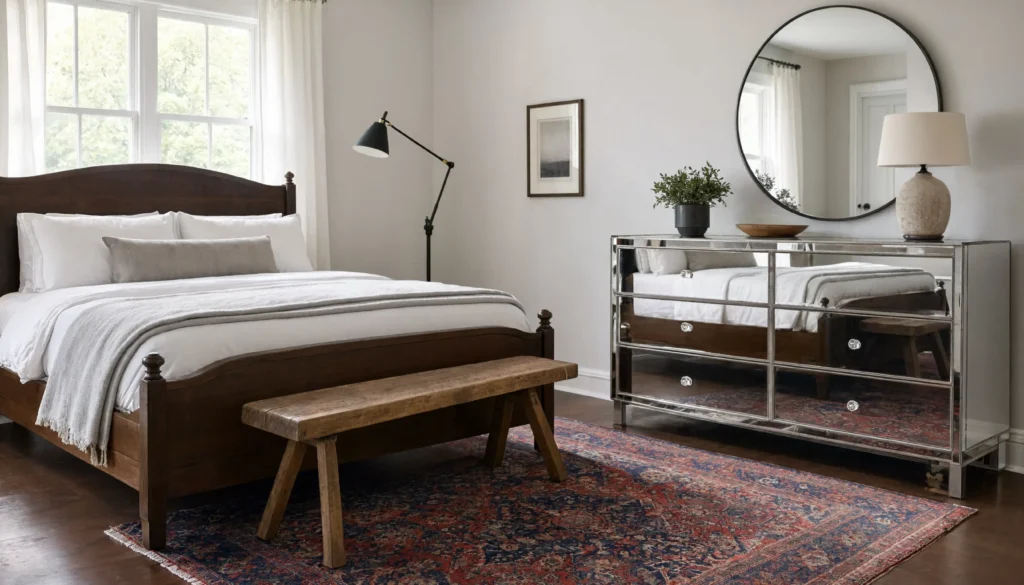
7. The Room Has Too Many Different Styles Fighting Each Other
A bedroom can become visually cluttered without having very many objects.
Sometimes the problem is that the objects look as though they came from completely different rooms.
Imagine:
A traditional wooden bed.
A very modern metal lamp.
A rustic farmhouse bench.
A glamorous mirrored dresser.
A colorful bohemian rug.
And minimalist black-and-white artwork.
There is nothing wrong with any one of these styles.
Together, however, they can make the room feel undecided.
The eye keeps noticing the differences instead of seeing a connected space.
This does not mean every piece of furniture needs to come from the same collection. In fact, overly matched furniture can make a bedroom feel more like a showroom than a lived-in home. Recent designer commentary also favors mixing pieces thoughtfully rather than matching everything exactly.
What to do instead
Look for something the different pieces have in common.
It could be:
- a similar wood tone
- repeated metal finishes
- a shared color
- similar fabric textures
- similar shapes or proportions
You can keep different styles.
Just give them something that connects them.
For example, a modern lamp can work beside a traditional wooden bed if another part of the room repeats the lamp’s darker finish.
The goal is not to make everything identical.
It is to make the differences feel intentional.
8. The Bedroom Has Too Many Heavy Visual Elements in One Area
Not everything that attracts attention is physically large.
A dark dresser can look heavier than a pale one.
A bold patterned chair can attract more attention than a plain one.
A black mirror frame can stand out strongly against a light wall.
A large piece of furniture can become even more dominant when it is placed beside other dark or high-contrast objects.
This is called visual weight.
It describes how strongly an object attracts the eye, rather than how much it physically weighs. Color, contrast, size, pattern, reflectivity, and shape can all affect visual weight.
This is why simply counting furniture pieces does not always explain why a bedroom feels crowded.
You may have only five major pieces, but if four of them are dark, bulky, or highly contrasting, the room can still feel heavy.
What to do instead
Look at where the strongest visual elements are concentrated.
If one side of the room already has a dark wardrobe, a dark dresser, and a large black mirror, adding another strong dark piece beside them may make that area feel even heavier.
You could soften the balance with lighter bedding, more visible wall space, or a less visually dominant piece.
You do not have to make every object light.
You simply want the strongest elements to feel balanced rather than stacked in one area.

9. Your Sightline Is Full of Distractions
There is another reason a clean bedroom can feel busy:
You can see too many things at once.
Stand in the doorway of your bedroom.
Do not look at individual objects yet.
Just look across the room.
What catches your eye?
A pile of items on the dresser?
Open shelves?
A television?
A collection of frames?
A chair?
A large mirror?
A bright object in the corner?
If several unrelated things appear immediately in your main line of sight, the room can feel more crowded than it actually is.
A recent approach to visual calm describes this as making the room easier to “read”: the eye needs a clear place to land and fewer competing details in the main sightline.
What to do instead
Try viewing your bedroom from the doorway.
This is useful because you experience the room differently when you are standing outside it than when you are moving around inside it.
Look for the first few things you notice.
Then ask:
Do these things belong together?
If the answer is no, you may not need to remove them.
You may only need to move one or two of them.
For example, a small collection of objects that is spread across several visible surfaces may look more intentional when grouped in one quieter area.
The goal is to create a clearer visual path through the room.

10. The Room Has No Visual Breathing Space
This is one of the easiest problems to miss.
You may have already removed clutter.
You may have organized the surfaces.
You may even have chosen a good color palette.
But if every wall, surface, corner, and piece of furniture is doing something, the room can still feel full.
A bedroom needs some areas that are simply allowed to exist without decoration.
An empty section of wall is not necessarily wasted space.
A partly clear dresser is not unfinished.
A visible patch of floor can actually make the furniture around it feel more intentional.
Design guidance around visual rest repeatedly comes back to this principle: reducing the number of competing elements gives the eye somewhere to pause.
What to do instead
Pick one area of the room and deliberately make it quieter.
It might be one side of the dresser.
Part of the wall.
The area beside the bed.
A section of shelving.
Then leave it alone for a while.
You may discover that the room feels better not because you added something, but because you finally gave the existing elements enough space around them.
That is an important difference.
A bedroom does not become more finished every time you add something.
Sometimes it becomes more finished when you stop adding.

How to Make a Clean Bedroom Feel Less Cluttered
Once you understand what is creating the visual noise, you do not need to change everything at once.
In fact, changing too much at the same time can make it harder to understand what actually improved the room.
Start with what your eyes notice first.
Start From the Doorway
Stand outside your bedroom and look in.
This simple viewpoint can reveal things you stop noticing when you spend every day in the room.
Ask yourself:
What do I notice first?
Then ask:
What do I notice second?
And then:
What keeps pulling my eyes around the room?
You may discover that the problem is not the number of things you own.
Perhaps the first thing you see is a crowded dresser.
Perhaps the bed has too many competing patterns.
Perhaps one large piece of furniture dominates the room.
Or perhaps there are several small areas demanding attention at the same time.
You do not need to fix everything.
Start with the first problem your eyes find.
Remove One Layer Instead of Redesigning the Whole Room
A common mistake is thinking that a visually busy bedroom needs a complete makeover.
Usually, it does not.
Try removing one layer.
If the bedding has several patterns, simplify the bedding first.
If the dresser has many small objects, remove a few.
If one wall has several decorative elements, take one away and look at the wall again.
If the room has several strong colors, reduce one of them.
Then stop.
Live with the change for a day or two.
This gives you a better idea of whether the room actually improved.
You may find that one small edit made a bigger difference than buying several new decorations.
Keep Personality Without Filling Every Space
There is a risk in trying to remove visual clutter.
You can go too far.
A bedroom does not need to look like a completely empty showroom to feel organized.
Personal photographs, artwork, books, plants, collected objects, and meaningful decorations are part of what makes a bedroom feel like someone’s home.
The goal is not:
Remove everything.
The goal is:
Make the things you choose easier to notice and enjoy.
One meaningful photograph can have more impact than ten small decorations that disappear into a crowded surface.
One piece of artwork can create a stronger focal point than several unrelated pieces competing on different walls.
A room can be simple without being lifeless.
Let Your Larger Pieces Do More of the Visual Work
If you keep adding small decorations because the room feels unfinished, stop and look at the larger shapes first.
The bed.
The headboard.
The rug.
The curtains.
The dresser.
The main artwork.
These pieces have a much greater effect on how the room reads as a whole.
Recent bedroom design guidance continues to emphasize proportion, furniture scale, and keeping the largest visual elements appropriate to the room rather than relying on many small decorative pieces.
If the larger pieces already work well together, you may need less decoration than you think.
Instead of filling an empty corner with another small object, ask whether the room already has enough visual interest.
Sometimes the empty corner is exactly what the room needs.
A Simple 10-Minute Visual Clutter Check
You do not need to spend an entire weekend reorganizing your bedroom.
Try this instead.
Minute 1–2: Stand in the doorway
Look at the room as a whole.
Do not start moving anything yet.
Minute 3–4: Find the busiest surface
Choose the dresser, nightstand, desk, or shelf that attracts the most attention.
Minute 5–6: Remove three small things
Do not throw them away.
Simply move them somewhere else temporarily.
Then look again.
Minute 7–8: Check the largest visual element
Look at the bed, largest cabinet, curtains, or main wall.
Ask whether it is competing with too many other strong elements.
Minute 9–10: Find one quiet area
Choose one wall, surface, or corner that can remain relatively simple.
Then stop.
You are not trying to redesign the bedroom in ten minutes.
You are simply training yourself to see what is making the room feel busy.
The Goal Is Not a Perfectly Minimal Bedroom
A clean bedroom can still contain books, photographs, patterned bedding, colorful artwork, plants, and other things you enjoy.
That is not automatically visual clutter.
The problem begins when too many elements compete for attention and the room becomes difficult to read.
A useful bedroom has a balance between interest and rest.
You need enough detail for the room to feel personal.
You also need enough quiet space for those details to actually be appreciated.
So if your bedroom is clean but still feels cluttered, do not immediately assume you need more storage, new furniture, or a complete makeover.
Look at the room differently.
Ask yourself:
What is competing for my attention?
What looks heavier than it needs to?
Where does my eye land first?
Is there anywhere for my eyes to rest?
Those questions can tell you much more than simply asking whether the room is tidy.
Final Thought
Your bedroom does not have to contain fewer things to feel better.
It often needs fewer things competing with each other.
That is an important difference.
You can keep the photograph you love.
You can keep the colorful cushion.
You can keep the books beside your bed.
You can keep the artwork that makes the room feel like yours.
Just give those things enough space to be seen.
A bedroom feels more settled when the eye can move through it without constantly being interrupted.
So before buying another organizer or decoration, stand in the doorway and look again.
Your room may not need more.
It may simply need a little more visual breathing space.