

The floor of a home is its most expansive architectural plane, a vast horizon that dictates the psychological volume of a room. In a minimalist environment, this surface serves as the silent substrate upon which the entire narrative of the dwelling is constructed.
A rug, therefore, is far more than a decorative accessory; it is a strategic intervention designed to ground the space. It defines a boundary without the aggressive permanence of a wall and offers a sensory shift without the clutter of a loud, disjointed pattern.
The modern shift from heavy, high-pile textiles to low-pile alternatives represents an evolution in our spatial awareness. We are collectively rejecting the suffocating “shag” of previous decades—a texture that trapped more than just dust; it trapped the visual energy of the room.
By choosing a lower profile, we invite a sense of cleanliness that is as much mental as it is physical. A low-pile rug allows light to skim across its surface rather than being swallowed by it, creating a thin veil that softens the architecture while respecting the floor’s visibility.
This visibility is essential to the minimalist philosopher. To see the floor is to acknowledge the honesty of the room’s foundation. As we explore these seven expressions, we begin with the subversion of the standard, rigid boundary.
1. The Irregular Boundary: Breaking Symmetry
Breaking away from the standard rectangular rug is a conscious act of rebellion against the clinical grid of modern architecture. A traditional rectangle demands perfect alignment with walls and furniture, creating a rigid structure that can often feel restrictive rather than supportive.
By introducing an irregular silhouette, one breathes life into the geometry of the home. The use of abstract contours—especially when rendered in a soft beige-cream palette—acknowledges that the natural flow of human life rarely follows a perfectly straight line.
In these shapes, we find a quiet center of gravity. These organic boundaries act as a designer’s focal point, adding a layer of personality and sophisticated movement that never feels forced or loud. The mind accepts the shape as a natural extension of the room’s flow.
Fidelity to the floor is maintained through a disciplined 0.24-inch profile. This knitted polypropylene construction allows the abstract shape to lay flush, integrating with the architecture rather than sitting on top of it like a foreign object.
The presence of a non-slip TPR backing ensures that this irregular boundary remains fixed, providing a stable platform for the movement of daily life. From this fluidity, we move toward the stability found in the repetition of ancient, centering geometries.

View details for: Modern Minimalist Off White Brown Line Art.
2. The Meditative Circle: Geometric Zen
There is a deep, psychological sense of tranquility associated with the circle. In a world characterized by sharp corners and industrial edges, the circular motif serves as a visual “centering” point, a target for the wandering eye to find rest.
Incorporating repetitive geometric motifs—specifically “Zen” patterns or “Reiki” circular designs—invites a meditative quality into the home. These patterns transform a mere thoroughfare into a destination of repose, creating an island of calm within the larger spatial sea.
The intentionality of these designs is further realized through the purity of their manufacture. A philosopher values a textile that is OEKO-TEX Standard 100 certified, ensuring that the foundation of the home is free from the invisible noise of harmful substances.
This 6′ x 9′ tan geometric rug utilizes a power-loomed construction that provides a soft, 0.4-inch tactile experience. This height is the perfect medium—thick enough to offer comfort to the barefoot dweller, yet low enough to maintain the room’s lean profile.
The sand-toned neutrals of such pieces reduce visual clutter by mimicking the hues of the natural earth. By anchoring a room with a symbol of wholeness, the space becomes a support for the quietude of the mind, leading us toward the sculptural potential of the weave itself.

View details for: Neutral Beige Area Rug.
3. The Sculptural High-Low: Texture as Color
The Japandi and Scandinavian design philosophies have long championed the idea that texture should perform the role typically reserved for color. In these traditions, depth is created not through a chaotic palette, but through the interplay of light and shadow on a surface.
This sculptural approach to floor covering turns the rug into a functional piece of art. Here, the “pattern” is not a print applied to a surface, but a physical ridge woven into the structural integrity of the object, creating a landscape that evolves throughout the day.
Consider the 0.25-inch pile height used to create a series of curved cream lines. These ridges form an understated landscape that interacts dynamically with the passage of time. As natural light shifts, the shadows cast by these ridges lengthen and retreat.
This creates what we might call “living architecture.” The rug becomes a clock, its shadows representing the quiet movement of the day. It provides a graphic punch through Scandinavian simplicity, proving that a rug can have presence without demanding a single loud hue.
Because the construction is machine-woven from robust polypropylene, the fibers remain crisp and intentional. This resilience ensures that the sculptural quality is not lost to the weight of furniture, leading us toward the even thinner, more unobtrusive elegance of the chromatic whisper.
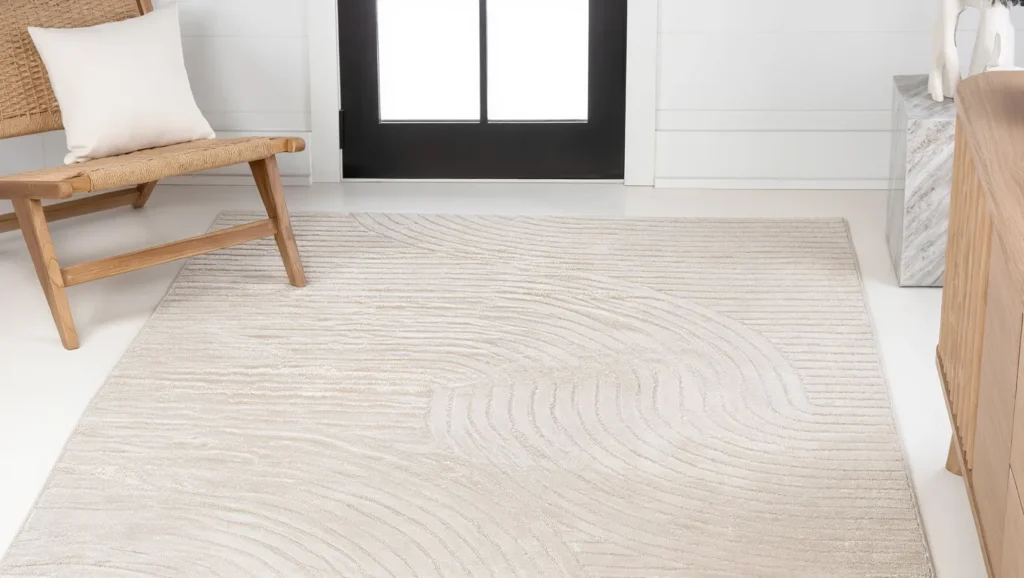
View details for: Cream Indoor/Outdoor Area Rug.
4. The Chromatic Whisper: Softness in Low Profile
Color, when utilized by a minimalist, is rarely an explosion; it is a whisper that influences the temperature of a room. Warm, muted tones, such as a dusty orange or sage, have the power to alter the emotional resonance of a space without overwhelming its inhabitants.
These “chromatic whispers” allow a space to feel vibrant yet grounded. They provide a visually grounding focal point that harmonizes with neutral décor. The success of this approach relies on a extreme commitment to the ultra-thin 0.2-inch profile.
This nearly flush construction is a triumph of modern engineering. It offers an “unobtrusive elegance” that treats the floor as a continuous plane. By sitting so low, the rug does not obstruct the movement of doors or create a trip hazard at the threshold of a room.
The polyester fibers, certified by OEKO-TEX Standard 100, maintain a velvety or soft feel that belies the rug’s thinness. It is a sensory trick—the eye sees a thin, manageable surface, while the foot feels the comfort of a much more substantial textile.
This ultra-low pile also serves the minimalist goal of mental ease by minimizing the hidden accumulation of dirt. It is a practical choice that facilitates a seamless transition through the home, eventually leading us toward the comfort of history found in faded, synthetic wools.

View details for: Boho Living Room Rug.
5. The Faded Memory: Softness through Synthetic Faux Wool
The “vintage” or “distressed” aesthetic in minimalist design acts as a bridge between the new and the old. It introduces a sense of history to a space, using “faded” tones to suggest a long-lived, comfortable existence that softens the sharp edges of contemporary life.
This design choice is not about nostalgia, but about the Wabi-sabi appreciation of the imperfect and the time-worn. Innovation in materials, such as the use of faux wool and recycled polyester fibers, allows us to achieve a “cloud-like” softness within a 0.3-inch pile.
These rugs provide a luxurious comfort that feels akin to treading on cotton balls. The multi-toned palettes—often a blue-griege-brown-beige-white—are particularly effective at hiding the visual “noise” of daily life, such as pet hair or the debris of a lived-in home.
Despite the visual weight of the traditional medallion or abstract print, these rugs remain physically light and foldable. This contrast—the heavy look of a vintage treasure paired with the lightness of a machine-washable textile—represents the height of functional modernism.
The use of a TPR non-slip rubber backing ensures that this large 8×10 surface remains a stable anchor. As we move from these faded memories, we turn toward a more vibrant, nature-inspired grounding found in the restorative power of earth tones.

View details for: Neutral Accent Rug.
6. The Verdant Line: Grounding through Earth Tones
Green is a restorative color, an invitation to bring the calming, invigorating influence of the outdoors into the sanctuary of the home. When applied to a minimalist rug with a “raised curved line pattern,” green serves as a statement piece that remains subtle.
The “contour-cut” or machine-woven raised lines on these 0.24-inch rugs add a tactile dimension to the color. This high-low effect creates a geometric wave that is visually grounding, offering a texture that the foot can explore without the burden of a high-maintenance shag.
A significant philosophical detail of this construction is its suitability for underfloor heating. In a minimalist home, the intersection of invisible technology (the heating) and the tactile surface (the rug) creates a profound sense of hidden luxury and thermal honesty.
Made from robust polypropylene and certified by OEKO-TEX Standard 100, these rugs are designed to handle high foot traffic while remaining easy to maintain. They provide a robust foundation that is both contemporary and deeply connected to the organic world.
This type of rug does not force itself into the foreground; it uses deep shades and tasteful patterns to bring life to a corner. This grounding in nature prepares us for our final expression: the woven arch, where geometry is felt as much as it is seen.

View details for: Modern Area Rug with Raised Curved Line Pattern.
7. The Woven Arc: Sensory Rhythms
A woven pattern possesses a rhythmic quality that a printed design simply cannot replicate. By utilizing two distinct heights of piles to create “rainbow arch” or “wavy line” textures, a rug becomes a purely sensory experience that invites touch and observation.
This “Zen garden” effect, where the surface is seemingly raked into patterns, serves as a reminder of our physical connection to the earth. Woven from a durable cotton-blend polyester, these rugs provide a breathable and ultimate cozy feeling underfoot.
The sensory experience of walking barefoot across these varying heights—ranging from 0.05cm (0.2 inches) to 1cm (0.4 inches)—is a rhythmic pulse for the body. The high-low pile adds interest and softness without the bulk or structural chaos of a traditional rug.
Because the patterns are woven with pre-dyed fibers rather than printed, they possess a structural integrity that resists fading. They represent the intersection of high design and extreme utility, offering a soft and fluffy experience that remains easy to store and wash.
These geometric wave rugs are versatile enough for the kitchen, bedroom, or bathroom. They conclude our journey by demonstrating that even the most functional of objects can be a source of profound sensory rhythm and aesthetic clarity.
View details for: Soft Fluffy Arch Pattern Area Rug.
Conclusion: Living with the Low-Pile
Choosing a rug for a minimalist home is a decision that extends far beyond the visual. It is a decision about how light inhabits our rooms and how we interact with the surfaces beneath our feet. The thickness, shape, and material are the quiet architects of harmony.
The low-pile rug offers the psychological benefit of “floor visibility,” a concept that respects the Void. Seeing the floor around the edges of a rug provides a sense of spatial honesty, ensuring that the textile anchors the furniture without suffocating the room’s architecture.
Whether through the “chromatic whisper” of a thin orange textile, the “meditative circle” of a sand-toned geometric, or the “irregular boundary” of an abstract silhouette, a rug should be felt through the atmosphere it creates rather than seen as a loud interruption.
In the quiet anchor of the low-pile rug, we find a way to live with beauty and utility. It is an unobtrusive layer of comfort that supports the architecture of the home, allowing us to dwell in a space that is fundamentally calm, curated, and profoundly still.


